385: The Art of Japanese Whisky: Savoring House of Suntory & The Perfect Toki Highball

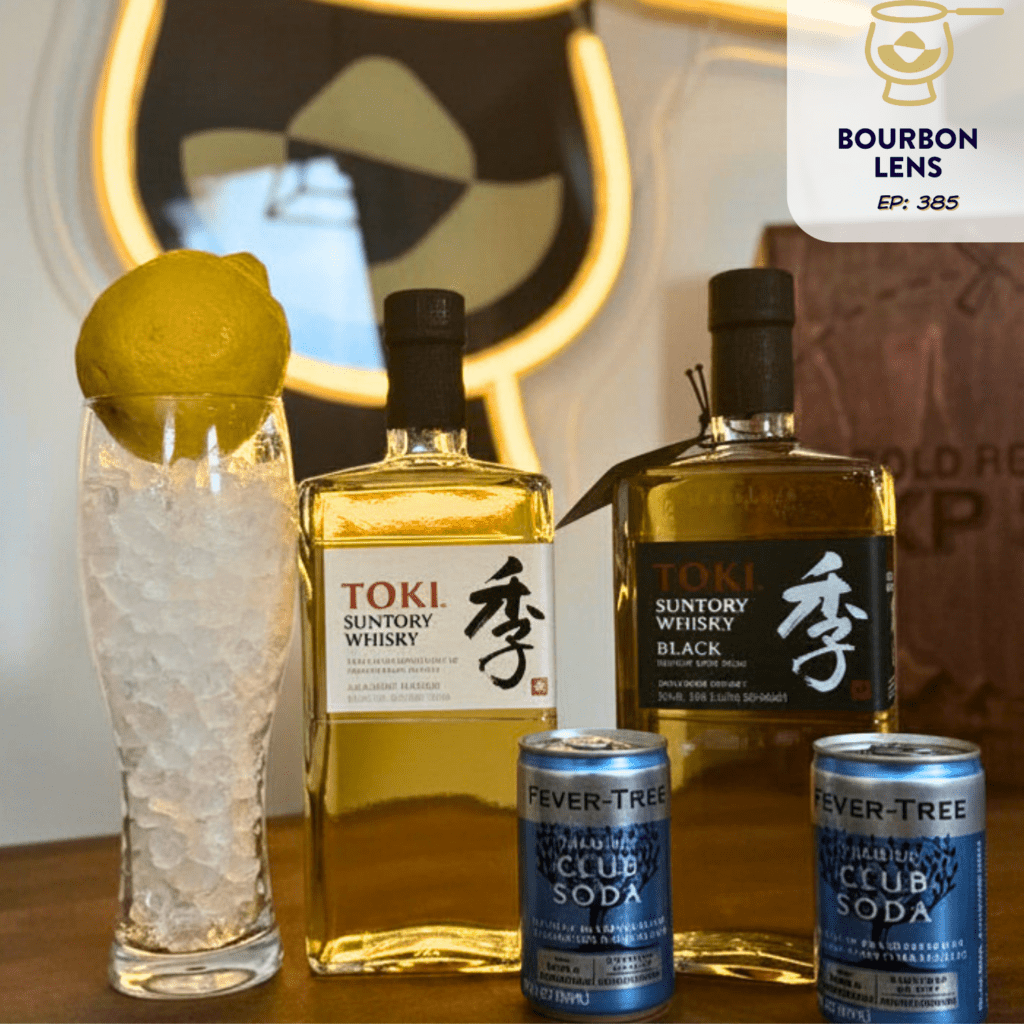
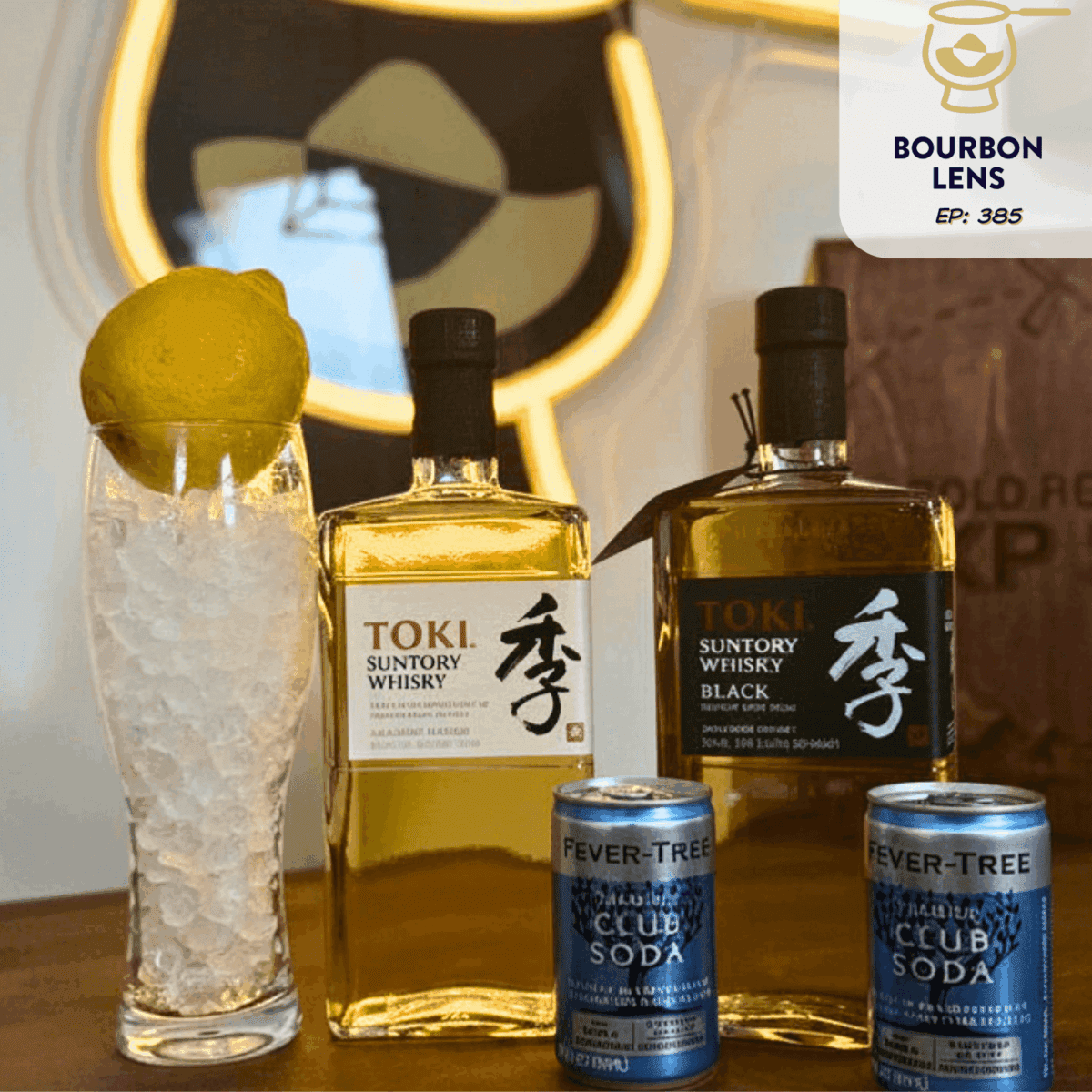
Toki White and Toki Black with a glass of ice, lemon, and two cans of soda water.

385: The Art of Japanese Whisky: Savoring House of Suntory & The Perfect Toki Highball

While our roots here at Bourbon Lens are firmly planted in American soil, our passion for exceptional distilling knows no borders. On the latest episode of the Bourbon Lens Podcast, we are trading the rolling hills of Kentucky for the pristine water sources of Japan.

We sat down with James Bowker, the brilliant Advocacy Manager for the legendary House of Suntory, to celebrate Toki Highball Week. Together, we deconstruct over a century of liquid craftsmanship, dive into the strict new structural laws protecting authentic bottles, and demystify the cultural philosophies that make Japanese whisky a global obsession.

More Than Scotch: The Cultural Heritage of Japanese Whisky

To truly appreciate what is in the glass, you have to look back a century to Shinjiro Torii—the founding father of Suntory who established the historic Yamazaki Distillery in 1923.

While early Japanese distillers learned their foundational mechanics in Scotland, the execution evolved into something uniquely Japanese. Driven by the philosophy of kaizen (continuous improvement), House of Suntory doesn’t just replicate old world styles. They utilize a massive variation of pot still shapes, fermentation techniques, and unique cask types—including native Mizunara oak—to blend spirits defined by unparalleled balance, subtlety, and floral elegance.

Combating Counterfeits: The New Authenticity Standards

For years, the Japanese whisky category operated like the Wild West. Imported bulk spirits from other countries could be bottled inside Japan and legally labeled as “Japanese Whisky.”

James pulls back the curtain on the industry-shifting regulations implemented by the Japan Spirits & Liqueurs Makers Association (JSLMA). To proudly wear the crown of an authentic Japanese whisky, a bottle must now meet rigorous criteria:

  • Mashing & Fermentation: Must use malted grains (and optional cereal grains), with saccharification and fermentation occurring strictly inside a Japanese distillery.
  • Distillation: Must be distilled in Japan at less than 95% ABV.
  • Maturation: The distillate must be aged in wooden casks within Japan for a minimum of three years.
  • Bottling: Must be entirely packaged within Japan at a minimum of 40% ABV.

This legal shift safeguards legacy names like Yamazaki, Hakushu, and Hibiki, ensuring consumers get genuine transparency in every pour.

Masterclass: Crafting the Perfect Toki Highball

The highball is far more than a simple two-ingredient summer drink; in Japan, it is a elevated ritual rooted in Ichigo-Ichie—the cultural philosophy of treasuring the unrepeatable nature of a single moment.

Suntory Toki was explicitly engineered by Master Blender Shinji Fukuyo to anchor the highball profile, pulling clean grain components from the Chita Distillery and heavy malt structures from Hakushu.

The Kaizen Highball Protocol:

  1. Chill Everything: Use a highball glass packed completely to the brim with dense, clear column ice. Pre-chill your bottle of Suntory Toki and your premium club soda.
  2. The Pour: Add 1.5 oz of Suntory Toki over the ice. Stir the spirit gracefully to chill the glass down further.
  3. The Carbonation: Tilt the glass and gently pour 4.5 oz of sparkling water down the inside wall. Do not pour directly onto the ice, as this breaks down the carbonation bubbles.
  4. The Lift: Bring the bar spoon up from the bottom of the glass exactly once. Over-stirring kills the effervescence. Garnish with a fresh twist of lemon zest.

Tasting: Suntory Toki vs. Toki Black

In this episode, we also get our hands on the elusive Toki Black. While the classic Toki is highly approachable, bright, and citrus-forward, Toki Black introduces a richer, subtly peated, and smoky expression. This heavier grain and malt composition makes it an exceptional candidate for heavier, stirred spirit-forward cocktails or sophisticated summer food pairings.

Listen to the Full Episode: Show Notes & Timestamps

Ready to elevate your highball technique and master the nuances of the House of Suntory portfolio? Stream the full episode below!

  • 00:05 — Welcome and Overview of the Episode
  • 01:06 — The History of Japanese Whisky and Cultural Background
  • 02:32 — Shinjiro Torii and the Origins of House of Suntory
  • 03:57 — Craftsmanship and Blending Techniques in Japanese Whisky
  • 08:17 — Suntory’s Product Tiers: Yamazaki, Hakushu, & Hibiki
  • 10:42 — Fighting Counterfeits: New Japanese Whisky Labeling Standards
  • 17:48 — Celebrating Toki Highball Week & the Ichigo-Ichie Philosophy
  • 19:17 — Masterclass: How to Craft an Authentic Japanese Highball at Home
  • 26:13 — Tasting & Comparison: Toki Classic vs. Toki Black Smoky Expression

Resources & Featured Links From the Show:

👥 Connect with the Bourbon Lens Community

🔔 Subscribe for more weekly discussions, deep-dive tastings, and independent spirits insights from the Bourbon Lens community.

#BourbonLens #SuntoryWhisky #JapaneseWhisky #SuntoryToki #HighballWeek #TokiHighball #Yamazaki #Hibiki #WhiskyEducation #BourbonLensNews #CocktailCulture

Listen to Bourbon Lens on your favorite podcast app or stream on Spotify. If you’d like to support Bourbon Lens, join our Patreon, sign up for our “Weekly Pour” Newsletter, and don’t forget to follow us on FacebookInstagram, and X.

Episode Transcript
Jake Lewellen (00:05.882) Welcome back to another episode of the both. man. I haven’t talked much today, apparently. Welcome back to another episode of the Bourbon Lens with your host Jake. We are excited to talk about the house of Suntory today and especially Toki Highball week. So sit back and buckle into the latest episode of the Bourbon Lens. We are joined by James Bowker, house of Suntory global advocacy manager. He gets a lot of dollars for every word he gets on his car. James, thank you for joining us today here on the Bourbon Lens. James (00:35.255) Thank you, Jake. It’s great to be here and great to meet everyone, albeit through a camera. Jake Lewellen (00:39.694) Yeah, no, it’s amazing. Big fan of Japanese whiskey, big fans of what the House of Suntory is doing. And there’s a lot of big news happening. But a lot of our listeners may not be familiar with Japanese whiskey as obviously we host a lot of bourbon conversations. Can you just tell us a little bit, one about yourself as we get into this and about the House of Suntory overall? Because it’s a very big spirits organization. James (01:06.797) Yeah, absolutely. So I’ll start by talking about Suntory because I think it’s a little bit more interesting than me, but Japanese whiskey has been around now for just over 100 years or so. So there was this incredible background to all of this happening where obviously all around the world 200, 300 years ago, spirits were being kind of invented. So you had the invention of whiskey, brandy, gin, et cetera, et cetera. And all of that was largely due to technological innovations that allow people to distill in new and exciting ways. Unfortunately, during that period in history, Japan was going through what’s known as the Edo period, which meant that the borders were entirely closed. You couldn’t leave or enter the country on pain of death. And so when that finally ended in the mid 19th century, so it’s kind of just after the 1860s, we start to see this sudden excitement across Japan about foreign technologies, foreign products, foreign ideas, because they just hadn’t had the chance to experience any of this stuff. Jake Lewellen (01:45.744) Mm. James (02:02.674) And very, very early on, the founder of Suntory, guy called Shinjiro Torii, he was working in a pharmaceutical organization at the time, so he understood chemistry. He had a great blending palette because back then a lot of pharmaceuticals would be like blended infusions of medicinal herbs and spices and tinctures and so on. So he started selling Western alcohol in Japan for this pharmaceutical company and very quickly basically got the reputation as the best palette for Western style spirits in the country. And he basically took advantage of that. was like, well, I’ve fallen in love with Western spirits, particularly I fell in love with whiskey. I’ve got this reputation of being the guy that knows the most about it, knows how to analyze them. And he opens a store, opens a shop in Osaka, starts trying to sell Scotch whiskey and other things, and just finds that, like, much as he loves it, and his countrymen are excited by it, the flavor’s just too intense for many Japanese people. If you consider, Jake Lewellen (02:56.878) Mmm. James (02:59.264) I grew up having black coffee every single morning and drinking red wine with my dinner. In Japan, it’s green tea and sake as opposed to espresso and red wine. so overarchingly, the idea of Japanese flavor is best understood by a sense of harmony and delicacy. So he just basically decided like, this is not going to work. What I do think will work though is if I can create something that meets that standard of quality we see from Scottish whiskey. but rather is tailored to the Japanese palate. It’s gonna have that lightness, that elegance, that refinement that is generally associated with Japanese flavor. And so he opens Yamazaki in 1923, go over the next 100 years or so, more distilleries open, changes the craftsmanship of how they make whiskey, but broadly speaking, Japanese whiskey is made very similar to Scottish whiskey, but with a greater degree of variation in distillation processes and maturation processes that then come together in the act of blending. So in Scotland, a single malt is pretty much just like one style of whiskey in a bottle. Whereas with Japanese whiskey, even if you think of something like Yamazaki, 12 year old, when the world’s, Japan’s most successful single malt ever, was the one in best spirit in the world a couple of years ago, like B out, not just the whiskies, but all of the other categories of the cognacs, the rums, that whiskey, despite being a single malt, is still kind of a blend because it’s a blend of… different fermentation styles, different barley strains, different peating levels, different pot stills and different casts, all to create this perfect sense of elegance and harmony. So that’s really the key difference between Scottish and Japanese whisky. And obviously your fans will be very familiar with the difference between Scottish and Japanese style compared to American whisky. Jake Lewellen (04:44.848) sure. And it’s so interesting because we always think of the Japanese culture, right as Americans as artistic, right. And I think that has been truly adopted in the whiskey process as well. It is pure artistry. We were talking about this in the pre show. If anyone wants to we’ll drop a link in the show notes. to go back and watch the artistry of when you all celebrated, I think it was the 100th year with Keanu Reeves and you all did this beautiful YouTube videos of all of that and people can go watch it and see the artistry and how it related to the artist of Japan or the artistry of something like sumo wrestling and how it all comes together to not just be an activity but a culture of the entire country. James (05:35.519) Yeah, absolutely that. I the whole history of Suntory, interestingly, for a whiskey is really unblending. And so I mentioned before this founder of Suntory, Shinjiro Tori, his background had been a blender in the pharmaceutical industry to create medicinal kind of liquids that tasted good. Then he opens his store. His first product actually wasn’t a whiskey. He was struggling to sell. He was also trying to sell like French and Spanish wines and it was not going well. They were too tannic, too full bodied. And so he blended those and created a kind of port kind of DJ Steefy style of wine called Akadama Sweet Wine. That was the first product. That was the first thing that went super successful. was that that gave him the funding to then open Yamazaki and later down the line create all the other whiskeys. And so from the very beginning, blending was like the first and most important element of the craftsmanship in Japanese whisky. And what that’s meant is that… if you’re blending something, there are artistic decisions. Like if you just distill, it’s kind of like a technical process versus an artistic process. As soon as you’re saying, well, do we have more or less of these different blending components? That’s just like an artist painting a painting or a composer deciding like which bits of the orchestra come out on top. And so whether it’s hibiki, which was a blended whiskey created to literally capture Japanese artistry. And we’ve got this amazing new campaign with, I don’t know you know Anna Sawai, the wonderful actress from Shogun. But she’s just come on as our global and brand ambassador for the Hibiki. And that’s really all about celebrating the last 40 or so years of how does Hibiki celebrate arts in Japanese culture. They’ve had like decades now of partnerships with people that make ceramics in Japan, people that, know, painters, literally poets, calligraphers, all sorts of things. And so Jake Lewellen (06:56.004) Mmm. Yeah. James (07:23.655) In case of Hibiki, it’s representing Japanese art history. In the case of perhaps Toki that we’re going to talk about a little bit later, that’s about celebrating ichigo-ichiyo, like special moments in times and torii times, right? The moments of connection you have with your mates where it’s a bit more relaxed, but it’s still nonetheless like a moment that you don’t want to forget. And so we always start with that kind of artistic vision connected to the culture and then blend something that, yeah, represents something that’s a little bit more meaningful than just tasty. It’s tasty and meaningful. Jake Lewellen (07:40.589) Mm. Jake Lewellen (07:51.346) 100 % and you just named a couple brands that people may be familiar with you will see you know, Hibiki Harmony pretty much regularly inside the US you’ll see Toki pretty regularly there. We talked about Yamazaki there’s Hakushu right? What other types of spirits is Suntory known for that people might you know run into out in the wild just so the consumer knows here what we’re talking about a little bit more broadly. James (08:16.298) Yeah, it can get very confusing because as you’ve mentioned with it, they’re quite a big company now. We see things as really divided into almost three tiers. So you’ve got the individual brands. So for example, Hibiki is a brand, Toki is a brand. Those sit underneath what’s known as the House of Suntory. So these are the products that are made still by members of the Suntory family over the last, same people that set it up over 100 years ago. And specifically these are made all in Japan and inspired by Japanese culture and artistry. So that would include Roku Gin which I’m sure some of your listeners will be familiar with, and Haku vodka, as well as all of our Japanese whiskies. So we have on the blended whiskey side, Toki, Hibiki, which is a more kind of our prestige expression of a blended whiskey. It’s kind of the most iconic Japanese whiskey. And then single malt whiskies, including Yamazaki most famously, as well as Hakushu. We also have a grain whiskey distillery. This doesn’t currently exist in America. I’m hoping that we will launch this at some point, but we have a single grain whiskey that’s kind of actually made similarly to a bourbon, not exactly the same, but it’s richer and more full-bodied than a Scottish grain whiskey, but less kind of sweet and spice forward compared to an American whiskey. So that’s Cheetah. You’ve then got a few other blends that kind of only exist in Japan, things like Cacobin, Jake Lewellen (09:19.295) cool. James (09:39.151) Suntory Old, Suntory Reserve, Suntory Royal, and a few others, as well as a liqueur range called Kanade. So there’s quite a large set of things, but the main ones really, Hibiki and Toki, as well as Yamazaki. Those are kind of the core three whiskies for us. Jake Lewellen (09:54.578) sure and it’s it’s really cool to kind of see the depth and breadth of the house of Suntory. I actually surprisingly enough, Hakushu has been one that I’ve really enjoyed and I’m not a big peat person but like I think Hakushu is a beautifully well done done whiskey and that’s for another time when we have you back on we’ll talk talk Hakushu sometime in the future. But there’s a big thing happening. So, you know, this has been going on for a hundred years, but there’s a big thing happening right now in Japanese whiskey overall. And that is the, I’m gonna have, I’m reading it because I’m gonna mess this up if I didn’t. The Japan Spirits Liqueurs Makers Association. So for the first time ever, there’s a now set of rules, right? That really make. what Japanese whiskey is because it used to be a little bit of the wild wild west to come of you know, what was Japanese and what was not So as you all see this like how do you all adopt something new like this? But also, you know be a part of the heritage of it all James (11:01.288) Yeah, I mean, it’s a really exciting time, to be honest. So you asked a bit about my background, and this is a good place to share this because it’s so relevant to the question. I used to be a bartender. That’s where I came from. was at university, which is we call college, where I’m from. So was at university basically doing my degrees. I did multiple degrees, and they’re very expensive. And so I needed to pay my way. was bartending. I was very, very lucky that the first whiskey that I tasted that I enjoyed was an old doesn’t exist anymore called Yamazaki 10 year old. And that was the first whiskey I tasted like, that one, that’s fantastic. And that kind of spurred an interest in Japanese whiskey kind of as far back as 2007 or so. And so from there on, my whole bartending career, Japanese whiskey was the thing that I was obsessed with. So was collecting bottles, promoting them, hosting events, learning as much as I could about them. And one of the challenges that I faced was that there just wasn’t very much information out there about what these products were. Jake Lewellen (11:46.253) Mm. James (11:58.312) And thankfully now we’re in a really good place. There’s a lot of good information out there. It’s great websites, a number of books. But even now, like it’s still not as transparent as Scottish or American whiskeys as an industry. And then around 2014 or so, there were some big moments in the kind of PR world of Japanese whiskeys. So most, most notably the Yamasaki Sherry cask 2013 was named the best whisky in the world. And even in the venue that I ran, there was this crazy change of affairs overnight. So we had a great Japanese, we had one of the biggest Japanese whiskey collections in the world as a five star hotel in the UK. we, this ward was one and there was a newspaper article in a kind of global, global newspaper listing some bars that you could go to to taste that award winning whiskey. And my bar was one of them. And we went from being only really busy on Fridays and Saturdays to being fully booked for months on end because people were coming in to taste this special Japanese whiskey. Jake Lewellen (12:31.056) Yeah. James (12:57.101) And whilst that was amazing, A, for my career, because basically I’ve been surfing this tiny wave and suddenly this wave starts growing and I managed to grow my own career, but also for the industry as a whole. The downside though, was it also created some negative incentives or some perhaps unfaithful incentives for people that just want to make a quick buck. And so there increasingly started to be fake Japanese whiskeys being released. So these were whiskeys that often were distilled and matured in other parts of the world, imported to Japan, blended in Japan, but then sold as if they were fully produced in Japan. There’s even products that we’ve seen around the world that were never even on Japanese soil at any stage, but they were labeled as Japanese whiskey, right? There are also products that were very, very young, under three years old. There were products that had neutral-gain spirits blended with them, as well as the whiskey. So there’s all sorts of kind of dodgy, strange practices going on. Jake Lewellen (13:41.199) Yeah. James (13:54.439) that was massively undermining everybody’s respect for Japanese whiskey and really creating a huge amount of risk, obviously for producers, but to be honest, a producer like us, we’re large enough that it’s not gonna significantly impact us. The bigger risk really is small producers that are trying to do proper craftsmanship. There’s been over a hundred distilleries opened in the last 10 years and there’s lots of good actors, but if they’re being undercut by bad actors, Jake Lewellen (14:16.421) Wow. James (14:21.318) they’re not going to able to succeed because real craftsmanship costs more. And then secondly, consumers, like it would be so sad if like, you know, Jake, if you and I had this conversation, you’re like, oh, the first ever conversation, the first ever whiskey I had from Toronto was X and I hated it. And then in back of my mind, I’m going, the X isn’t even a Japanese whiskey. It’s a fake one, right? That would be a sad situation. So what you’re describing is we didn’t have any rules. So Scottish and American whiskies have laws about what you can call that whiskey. Japan has never had that. Jake Lewellen (14:39.409) For sure. James (14:50.294) And so as of 2024, there are now rules in place about what can be labeled a Japanese whiskey. But unfortunately, there are still kind of they’ve not been kind of established as a GI. So it’s not legally enforced at the moment, although we can get into the detail of how it works. But it basically means that all Japanese producers will follow this this this stipulation about what can be called Japanese whiskey. The challenge really, though, is how does a normal person just going to the shops, like how do my parents and my siblings who aren’t massive nerds like me identify which are the real Japanese whiskeys and which are the kind of ersatz fake ones? And the big news now that’s brand new is that there’s a trademark. So you know when you buy chocolate and it says fair trade on it, there’s an equivalent of that for Japanese whiskeys. There’s a stamp that’s gonna be put on the labels. And if you see this stamp, you can feel confident that one is a real Japanese whiskey. And we’re super lucky at the founding house of Japanese whiskey, the house of Suntory, Jake Lewellen (15:26.385) Yeah. James (15:48.279) All of our products are a authentic Japanese whiskeys that compliant. They’ve got this logo on them. And as of June, it will be going onto the Tokyo logo, for example. So I Tokyo label rather. So it’d be so much easier for us to just find real whiskeys and not stress. Like, am I drinking Japanese or drinking something else? Jake Lewellen (16:07.324) For sure, and that was one of the things that when I got into this, you you do a quick Google search and you’re like, there’s that, this is, and then you’re like, well, you just gotta go with the trusted name brand at that point, right? And you’re gonna pay more for the name brand and the craftsmanship. Also, there’s a little thing called taxes and imports that you gotta deal with. That’s a whole thing. That drives cost. But the stamp will be really easy. It’s got a big JW in the middle of it. It says Japanese whiskey and then JL, J S L A, which is a mouth fill, but it’s important, right? It’s, much like the, branding standards that we’re used to here in the States, right? Kentucky straight bourbon whiskey, right? That all means something, right? So you see that stamp and you know that it means something. And I think that’s the most important thing. You may not know what it means, but a quick picture and ask chat GPT, it’ll tell you exactly what it means and why it’s important. James (17:00.588) Exactly. And because at the end of day, none of, we don’t all need to be nerds, right? We need people just to relax and enjoy stuff. And like giving people the chance to relax is like the greatest gift you can ever give someone. Jake Lewellen (17:12.06) For sure, which brings us into relax. You you kind of brought that into the idea of. of Toki, right? And what it is all about. And this week when this podcast drops, we’re going to leap forward to June 1 to celebrate Toki Highball Week with this. And so it’s really cool. I think a highball is a really great, easy drink to make. were talking about how to make one. We’ll talk about that here in a second. But for for you, like, how do you envision, you know, people celebrating Highball Week, you know, across America or across the world? Like, how do want people to to enjoy that. James (17:52.74) I mean, Toki, the name of the brand means time in Japanese. And this is a reference to a Japanese expression that goes Ichigo Ichie, which means one moment, one opportunity. And this expression is at the heart of the tea show. It’s the heart of all hospitality from great restaurants to great bars. And it basically is about recognizing that every moment is fleeting and they’re never going to be repeated. So every chance you have to see someone that you love and embrace that moment and really be present, put your phone down. Jake Lewellen (18:03.059) Mm. James (18:21.396) really focus on just that connection, that individual moment in your life. That’s what Toki time is all about. That’s what Suntory time is all about. And that’s what Haiba week is all about. So find people you love. It doesn’t have to be a fancy occasion. It can be whatever you enjoy and just, just go and relax, like properly turn off and be present. Japanese culture is all about, I mean, like it’s a Zen culture, right? And Zen literally means presence. So be present and, and try Japanese highball experience. People drink highballs like they drink beer in Japan, so actually the highball is better selling even than beer. It’s the refreshing drink that you have to to relax that goes with food, it’s kind of an after-work beverage, it’s something that’s sessionable as well, so you don’t have two of them and feel like your palate’s been overwhelmed. It’s kind of simple insofar as it is just whiskey, ice and soda, but the devil is in the details. It’s about the correct apportioning of those two elements. and then also the correct temperature and carbonation. If a highball is not crisp and super carbonated, it’s a whiskey and soda. Whiskey and soda is a flat highball, as far as I’m concerned. And so to your best is my advice to find a venue that’s doing great highballs. It’s hard to imagine just how different and how much more enjoyable that experience is with that great carbonation. we’ve actually designed our own machines. So you know what Japan’s like with attention to detail. Jake Lewellen (19:45.553) Yeah. James (19:47.139) We partnered with one of the most revered dispensers, so they’re an ice making machine, they make all sorts of other kind of top-end Japanese technology. These guys, Hoshizaki, worked with us to create the perfect Heibou machine that gives you this ultra cold, ultra fizzy Heibou. We’ve got a great website, find the venues that are hosting and go and try like a real Japanese Heibou, get some snacks and enjoy that casual moment of being in an Izakaya. Jake Lewellen (20:11.558) Yeah, so I’m all about that. The Louisville based one that I would go to if you’ve never been to Louisville and had a highball, go to Seven down in NULU which is on Market Street. they have, I don’t know if they have the exact machine, but they have a Toki dispenser that is super carbonated, much like you would see a fresh pint of Guinness. a Guinness is by itself in its own system. They’ve got their own highball system set up at Seven and it makes a beautiful, wonderful highball, which is crisp and enjoyable and you can get a charcuterie and enjoy life. It’s not one of the. many cities listed here, but it is, you know, going June 1st through June 7th. So Chicago, New York, Los Angeles, Miami, Philadelphia, will have in Pittsburgh, will have all ways to celebrate this at a couple select details. We’ll have all the information in the show notes. If you want to celebrate Highball Week and you are in one of those locations, or if you’re in Louisville, you can celebrate Highball Week at seven and we’ll put the details to where to get to seven here. Cause you know, it might not be part of the list, but it it is a great experience nonetheless. James, if you ever get down to Louisville, that’s where I would recommend going and having your nice highball. You know, you’ll be tired of whiskey or bourbon at that point, you know, you want something light and refreshing. Which James (21:28.898) I saw a man. Well, I’ll be down a little bit, hopefully later this year. So I’ll make a stop for sure. Jake Lewellen (21:31.674) All right. Well, if you’re in town, you give us a call, we’ll make sure we meet up, we go have a highball. But it’s important, let’s talk about how to make a highball. And this is my Japanese term that I will bring to the conversation today. And it is kaizen, which means continual improvement, right? How about that? You didn’t think I wouldn’t know that one today. But as a bartender, you know about the process of kaizen. It’s continual improvement, right? How do I make this a little bit better, a little bit better, and a little bit better? And dialing in a cocktail. James (21:51.426) You got it. Jake Lewellen (22:02.331) You can have your proportions wrong right away. So I Googled it, I didn’t know, and I asked you in the pre-show, what’s your ratio? So I have a very giant, this is almost a beer glass, it is a beer glass, and I did. A three to one is what I did. Toki to a nice easy fever tree. Pick your favorite carbonated club soda and go for it. I think they are actually pretty carbonated, so I like that one. And then a slice of lemon. So I did three to one Toki to carbonated club soda with a slice of lemon. How would you go about building a basic highball? James (22:43.798) Yeah, absolutely. So there’s a lot of different styles of Heibel in Japan. So you have about 100 years or so of it being the most popular drink across the country. And unsurprisingly, it’s kind of got this family tree of different styles. So there’s the oldest unique Japanese style called a Kobe Heibel. There’s no ice in that. It’s quite an unusual style. Then you have the Izakaya style, which is almost like a pint glass with a, you like a kind of German style beer glass. Jake Lewellen (22:57.723) Yeah, for sure. James (23:11.382) That’s a much more diluted drink because it’s generally being paired with quite fatty foods, so fried foods and so on and so forth, so you have a lot more soda to cut through the fats a bit more. And they also squeeze like a whole wedge of lemon in there to give it just a brightness and an acidity. Both of those styles work brilliantly with Toki, and yours is kind of a halfway house, one that you’ve made, because you’ve got that citrus in there as well. And generally speaking, the kind of posh classic Japanese highball that we do with Toki, It’s kind known as a Ginza style highball. So Ginza is a very fancy high end area of Tokyo where most of the best bars historically would have been. So with a great highball, it’s a very simple drink. It’s whiskey and soda with ice, right? And therefore the details are what makes the difference between a good and a great highball. Generally speaking, you want to be aiming for quite a delicate glass. When I was working in Tokyo at a bar out there, they would say you want to be able to feel the bubbles popping against the side of the glass. Jake Lewellen (24:08.967) Mmm. James (24:09.419) So if you’re holding it, it’s so thin and so delicate, you can really feel that effervescence in your hand. Then you want to make sure that that glass is super, super cold. In fact, all ingredients should be super cold. That cold temperature protects the carbonation, keeps it fizzy for a long time. So ideally, keep your whiskey and your glassware in the freezer. Take them out, add your ice. You want to go for around three to one, up to four to one, depending on your personal preferences in terms of the strength of the alcohol content. And then basically just very gently add the soda water so that it doesn’t fizz up inside of the glass. Avoid, if you can, like don’t do the whole beautiful trick where you put it down the spoon. I don’t know if you’ve seen people doing that. That takes all the bubbles away. Try not to pour it directly onto the ice. That also gets rid of the bubbles. Just very gently add it to the glass. A gentle stir so that it’s neatly integrated and you’ve got a good mix between the soda and the whiskey. And then we recommend Fetoki because it’s such a fresh, clean, elegant style. We just take a little zest of the pink grapefruit, pinch that over the top and pop it into the glass because you don’t need all the juice from the lemon because there’s already so much vibrancy and fruitiness in the whiskey. Jake Lewellen (25:15.665) Yeah, for sure. So that leads me into what makes this actually stand up and that’s the whiskey itself, right? And so we have two, your team was very nice enough to send us two versions of Toki, which I keep behind me here. So we have the white label here, which is. I think just the traditional blend 43 % alcohol by volume or 86 proof and then Toki black Which is a subtle smoke right smoky and rich is what it what it says I’ve never had the black straight up So I’m interested to try that today. And so we’re gonna walk through just a little tasting here of these two whiskies overall Which one should we start with I would assume the non smokey one James (26:03.357) Yeah, we’ll start with the core expression. So we’ll start with toki as is, and then we’ll taste toki black. James (26:13.546) So I’m not the sort of whiskey taster that has a specific way to taste a nose, but if any of the audience are new to nosing whiskies, generally speaking, something that’s going to allow you to get the aroma is the right type of glass. So wine glass is also fine. I also recommend not going, you and I, Jake, are kind of pros. We do this a lot. If you’re new to nosing whiskey, don’t like jab your nose all the way in the glass straight away, because it will just be overwhelming. And the same goes when you take your first sip. I normally recommend to take a fairly small first sip, allow that to sit on your palate, your palate gets used to the alcohol, and then when you take your second sip, you’ll start to notice more flavour. But even for the most kind of complete beginners on this cool, when you take a taste, you’ll notice it’s got none of that burn, none of that harshness that you get in like lower quality whiskeys. It’s really fresh and really smooth. In terms of the blend itself, When I nose it personally, I mean, the first thing I notice is it’s so much more delicate, it’s so much lighter compared to a Scottish or an American style whiskey. It’s got that soft sweetness we get from American whiskeys and it’s also got the complexity and kind of depth that we get in a Scotch, it’s balanced between those two styles with that Japanese lightness. I also get a lot of fruity nose, primarily on the nose. Jake Lewellen (27:35.367) I was gonna say it is very fruity on the fry. And you said this is a blend of whiskey. So is this single grain, single malt? What kind of goes into the components of Toki? James (27:49.79) It’s a good question. it’s a blended whiskey, which is following the kind of Scotch definition of a blended whiskey, meaning as you say, it’s got a combination of malt whiskies and grain whiskies. This is being a House of Suntory whiskey only made from our own distilleries. So other Scottish and Japanese producers might buy from other distilleries. At the House of Suntory, we only blend using our own whiskies made in Japan. So we have Yamazaki, which was Japan’s first ever distillery. opened in 1923. You have the Hakushu Distillery, which is the one you mentioned that you particularly love that’s up in the mountains and that opened in 1973. And we have Cheetah, which is our grain whisky distillery. And actually, interestingly, and you’ll be glad to hear this as a Hakushu lover, this is mostly Hakushu, is the main flavor element. Now, when you think about a traditional Scottish blend, the general kind of industry standard is it’s around 80 % Jake Lewellen (28:32.058) Okay. James (28:42.14) grain whiskey and that grain whiskey is intended to be very neutral because it’s mainly about lengthening the flavor of the malt. The malt will be around 20 % but that’s where the majority of the flavors coming from. For Toki, we decided on kind of throwing that recipe out of the window and going with an entirely new approach. So we’re aiming for a 50-50, an equal balance of the profiles of the grain and the malt. So two big changes there. One, much more malt compared to a traditional blended whiskey from Scotland. Two, the grain whiskey is not neutral. The grain whiskey is a full-bodied, quite chocolatey, quite caramelized and creamy style of grain whiskey from Cheetah. So you’ve got the heavy type grain whiskey from Cheetah Distillery that’s mixed roughly equally with Hakushu malt whiskey, which brings a lot of pear, orchard fruit, saucer flavors and some herbal notes. And then finally, a small sprinkling. It’s actually known by our chief blender as the salad seasoning component because he sees it as being like balsamic vinegar. Jake Lewellen (29:31.016) Yeah. James (29:40.87) on a caprese salad. So it’s only a small amount, but it significantly alters the profile. And that’s going to be an old Yamazaki sherry cask style of whiskey. So those are the three main elements that get blended together to create Turkey. Jake Lewellen (29:40.967) Yeah. Jake Lewellen (29:55.188) And it’s so interesting because you get just the wisp of sherry like on the nose like at the back end you get a wisp of that that dark sherry note which is really nice that kind of balances all of it out and know, grain whiskey has been something that I’ve wanted to explore, right? Cause a lot of it has like a bourbon mash to it, right? It just can’t be called bourbon. And it’d be interested, you one day I want to get to Japan and do all the distilleries. Like that’s something that I would love to do. And to see like, you know, cheetah like, cause it’s making what we would, you know, assume as like bourbon style whiskey, but it’s going to be different cause it’s Japanese. so be interested in know like grain bill and all those like unique things that go into those. you know experience to make this 50-50 ratio because it’s important to be able to balance the you know probably you know eight nine ten year old casks right with you know something probably with the younger to get the the right flavoring profile James (30:54.289) Yeah, so the difference between cheetah grain whiskey and bourbon is really interesting. It kind of sits halfway between a bourbon and a Scottish grain whiskey in terms of its style. I’m going to assume that your listeners know how bourbon is made, but just a brief intro on Scottish style grain whiskey. It’s generally speaking, very, very high proportion of corn and a small amount of malted barley. There’s just chemistry as to why you need to add malted barley to create the chemical reactions for whiskey making. And so the first thing is generally Scottish whiskey is mostly corn. Secondly, it’s distilled in a continuous or a column still as opposed to the stars of stills that you would see in in Kentucky. And even where you do have column stills in Kentucky, you’ll often have a doubler or something like that that’s adding more of that copper contacts, that boldness, that richness. So that’s that basically means that in the Scottish grain whiskey industry, the whiskeys end up being very, very clean, very delicate, almost neutral in their flavor. At the Cheetah distillery that Suntory built in the 1970s, they basically wanted to get more complexity into grain whiskey, as well as more body, more mouth feel. And so what they did was they designed a brand new style of still. So it’s a variation on the continuous still. They patented that. And basically what this allows us to do is to create three different styles of grain whiskey from one still. And this by having basically different points in the distillation process that you can tap off what you’re using. Jake Lewellen (32:06.644) Mm. Jake Lewellen (32:23.442) Yeah. James (32:23.598) And so we use the most full-bodied version of that to make Toki, and then some of maybe the lighter bodied expressions used to make things like hibiki, which is a slightly more delicate Japanese whiskey. The mash bill, to answer your question, is different depending on if we’re making a clean type, medium, or heavy type grain. In this case, Toki uses heavy type, which is much, much more malt. So I don’t know. I believe it’s something like… Jake Lewellen (32:34.932) for sure. James (32:51.644) 70 % corn, 30 % malt or something, whereas the Scottish style would be like 95 % corn and only 5 % malt. So way more malt, but malted barley in there, much more depth and therefore richness in that grain whiskey. Jake Lewellen (33:02.962) Yeah. Well, so I took a sip and that’s when the thing I would say is, the body and character, right? I think the grain whiskey Scottish or Irish is like, it’s, it’s punchy, right? Like it kind of like it’s there and it’s, thin. This one has a lot more viscosity in it. A lot of thickness. The sherry notes kind of go away, but the orchard fruits and the sweetness of that corn really start to stand up on the palate, which, you know, it’s not, wouldn’t say like overly complex, but it’s well balanced, right? I think that’s the most important thing. Like this is gonna be not a whiskey you’re sitting down to. like contemplate life on like this is one that you’re obviously Toki time, right? You’re supposed to enjoy it. But it does have a little bit of nuance to it, but not in one where you’re just going to sit there and like pontificate like world’s problems. That’s for a much older that’s for your Yamazaki 40 year or you know, the, Mizunari cat, the 25 year old Mizunari cast, right? You’ve paid, you’ve paid for, for yourself to look at those problems. This is just a, you know, enjoy your, your life and whatever games on the. TV but this is a very enjoyable sip. James (34:16.742) This is exactly it. I mean, we talked a bit about the history of Japanese whiskey before and how like 10 years ago the industry just exploded. This really was quite, I mean, I mentioned the challenge of the fake whiskeys. One of the other challenges was the supply and demand meant that Japanese whiskey got very expensive and very rare really quickly. And so one of the kind of vision or like one of the ideas behind the vision of Toki was let’s create an accessible Japanese whiskey that is actually Japanese, properly authentic. Jake Lewellen (34:33.554) Yeah. James (34:46.191) but also is something that can be enjoyed properly in any instance, right? Sometimes if you’ve spent a lot of money, it’s impossible to relax because you’re like, my God, I need to focus on maximizing my enjoyment of this whiskey. Toki’s there to be like, okay, this is gonna be everything you expect. It’s gonna be elegant, it’s gonna be complex, but also just enjoy it, you know? Don’t stress because you can easily find another bottle at the supermarket the next week. Jake Lewellen (35:12.052) For sure, if you’re looking for this total wine in Louisville $45. I mean, it’s a very approachable bottle. 86 proof, I would say it stands up. I think it drinks a little bit more proofy than 86. I think that’s just the way it’s balanced and blended together. I would say most Japanese whiskies feel bigger than what the proof is on them because of the, just the artistry of it all. So. It’s a very easy drinking. I see why it works perfect in a high ball, right? I’ve never tried it as a base spirit. I’ve only had, know, Hibiki has been kind of where I’ve set my, you know, kind of seed in when I have ordered a lot of Japanese whiskey out or, you know, have Japanese whiskey with friends, know, Miyazaki 12 or whatever. you we haven’t gone to Toki. So this is a really enjoyable whiskey and it’s summertime, it’s by the pool. It’s like, you always think about how can you have whiskey during summer? Like this is a great summer style whiskey. James (36:14.938) Yeah, I was actually down in Austin, Texas a few months ago, the same with a really good friend of mine. And they have this beautiful place is on Austin Lake. It’s a wonderful, wonderful experience. And there’s that interesting time of day where it’s like basically the end of sunset and it’s starting to get like towards cooler temperatures, but you’re still not ready to move on to like a fully rich, heavy style of whiskey. We were just drinking toki neat on the rocks at that point, because it was like, this is the perfect late evening kind of. Jake Lewellen (36:39.732) Mmm. James (36:43.372) It’s still hot, it’s still summery, I don’t want a highball, I don’t want a long refreshing sodary drink, but I also don’t want something big and punchy, it’s just soft, elegant, got a touch of complexity and I can relax with my friends. Jake Lewellen (36:54.354) Yeah, no, and that’s exactly what that is. And so moving on to the Toki Black, I’m interested to know a little bit about this and why it is different and how it is different. James (37:08.056) Yeah, totally. So this is the product I’m wildly passionate about. It’s a product that I worked really closely on and so had the opportunity to work with the blenders on finding the right recipe for this. really what this is about is realizing that if we’re talking about Suntory times, if we’re talking about this idea of Ichigo Ichi and having moments to celebrate and really be present with your friends, there’s quite a lot of variety in those. And not all of them are those like hot weather occasions that we were just talking about, right? Sometimes you do want to have a highball and you want to something refreshing by the pool. Other times you want to have a neat whiskey like I just mentioned, but still something that’s softer and lighter. But there’s a whole bunch of moments that you want something slightly more full bodied, something more that’s perhaps like a, as you said, would say like pontificating about the world. Sometimes you do want those moments and you want them if you’re not spending necessarily hundreds of dollars on a whiskey. And so Toki Black was about opening up a whole new set of Tontori times, a whole new set of Ichigo Ichi moments with your friends. And this whiskey is a little bit richer, a little bit smokier, and consequently lends itself to a different style of neat sipping, as well as a different style of cocktail. So where Toki’s core expression is great in whiskey sours, in high balls, in like those kind of brighter styles of cocktail, Toki Black goes really well in those stirred down drinks. So things like a Manhattan, old fashions. that style of drink. And so it’s really just saying, whoever you are, there is a Suntory time for you. There is an Ichiguchi moment for you and your friends in whatever mood that you’re in in that moment. And so yeah, we’ve added more sherry cask whiskies. And then we’ve added more heavily peated Hakushu. So there’s even more malt in this whiskey compared to the Toki Kou. And then finally, very, very interesting component in the grain whiskey. We have Cheetah as our main grain whiskey distillery. We also secretly for many decades, but secretly have had a column still, Kofi style column still, miniature Kofi still hidden at the Hakushu distillery that’s used for testing and development. And so we used the grain whiskey distilled at the Hakushu distillery in this miniature Kofi still, which is hyper oily, hyper rich and like just unctuous in its flavor profile. And so yeah, we’re getting, as I say, smokiness and richness. That’s why we popped it on the label. Jake Lewellen (39:31.272) Yeah, you can smell the fattiness on it. It’s less apple, like more baking spices in this one as well, like little more cinnamon clove kind of notes. But like, know, lot of times when you, you know, everyone’s had an Isla Scotch experience probably at this point in their life, or they’ve walked by someone who has an Isla and you get that medicinal note. The one thing I like about the artistry of like Hakushu is like, yeah, it’s peated, but like it’s not to the point where it’s like iodine or medicinal, right? If there’s some vegetal notes in there, but it’s not like over vegetal. And so it’s still really approachable. like, you you talked about this in a cocktail, like I’m thinking about like, okay, you could split base this, right? You could get a really nice, like, like a 95 five rye and you put this in, now you have like a really smoky old fashioned, like a half and half type deal. Cause you’re going to get, you know, more accentuations from the flavor profile. And I think that would be a fun way to experiment with these things right here. So let’s take a test. James (40:37.944) Totally. I mean, my careful one that often upsets my friends in the southern states of the US is a Japanese whiskey Sazerac. So obviously you mentioned split based cocktails. There’s this whole debate, you it used to be made with cognac, then it became rye when they became hard to get hold of in New Orleans. And now a lot of places will split the two. For me, Japanese whiskies get the best of both of those worlds. You’ve got the kind of elegance and softness of a cognac, but you’ve also got the richness and complexity and spice of a whiskey. but you’ve got them both in one spirit. whether it’s, I mean, my favorite ever Sazerac is a bit bougie as the Yamazaki 12 Sazerac, it’s like insanely awesome. Whether it’s though that Hibiki or either of the Tokis, that style of cocktail is just perfect. Jake Lewellen (41:24.405) Yeah, and I love the robustness of this. The smoke stands up on the palette, perfect for barbecue. You think about, my mind always goes to pairing it with something, right? The time that I’m doing it with. This is great for your pairing moments. If you want a… Nice pulled pork sandwich like this would go perfect with that right over ice and now you’re just enjoying a Nice day because you’re gonna have like that sweet sauce balanced by the smokiness of the barbecue balanced by the smokiness of the whiskey and a little bit of the The spices there, but also a little bit of the fruity notes. I think would be a really nice Time so now it’s like okay. Well now I have my summer whiskies and I’m gonna celebrate highball week here coming up I have to now James (42:15.991) Yeah, dude, mean, it’s become one of our, my friendship group has become a regular thing for us. We’ll just pick up, you know, the like large ice cubes that you can get, you can make them yourself and you can sometimes buy them in the store. We literally just put out a tray of those large ice cubes with some rocks glasses and then the toki. Oftentimes with a barbecue, like with some brisket, it is the most incredible little pairing. Jake Lewellen (42:36.233) Yeah, it’s beautiful. mean, it’s really nice whiskey. I didn’t know what to expect, right? When you’ve tried the high-end stuff and when you talk about high-end whiskey, the houses and tours got it, right? I’ve not been able to try all of it, but I’ve tried a lot of it and it knocks your socks off, how good it is. But then even the lower end, and I hate to say it that way, but even the lower price-pointed whiskies, because there’s a tier for everybody to get in on Japanese whiskey. This is super approachable. Like a bourbon drinker, I think would like the regular Toki. A scotch drinker would like the black, right? I think you have the mix of it, especially if you’re a Highland or an Islay guy, like the Toki black is like a perfect blend if you’re coming from scotch into this or a turfed Irish whiskey, right? I gotta get my terminology right, because they don’t call it peated. You know, like I think there’s a little bit for everything and Think you know one thing I will say throughout this it’s all about artistry and it shows up in every one of their whiskies That you all have created and so I just want to say thank you for spending some time talking about the artistry of the whiskey because it’s it is beautiful and you all do have fun with it even though it is artistic and You know so much heritage and so culture rich you still make the Japanese whiskey culture Fun and enjoyable even for us Americans and the rest of the world to enjoy James (44:06.806) Well, I’ll thank you on behalf of my colleagues in Japan. I’m of course not Japanese. It surprises everyone that I’m not Japanese, but it’s pleasure. the whole thing is that, again, it’s about people. It’s about memories, about moments. And if whiskey is only about sitting in front of a fireplace and acting all serious while you nose a glass, no one wants that, right? So this is just offering a taste of Japanese culture. And really, it’s really about sharing what makes Japan beautiful in a different form. That’s ultimately what Suntory is all about. So I’m glad you’ve enjoyed it as much as you have. Jake Lewellen (44:42.173) No, I really appreciate it. Thank you for spending some time with us here today ahead of Highball Week. This will release during Highball Week. So make sure you celebrate three to one. That’s your ratio. Go from there and then Kaizen. Continually improve your own highball from there. But James, really appreciate it. House of Suntory, thank you for giving us some whiskey to try today. And we’ll catch you next time on the Burby Lens. Cheers. James (45:05.91) Cheers. Thank you very much.

Listen & Subscribe

Never Miss A Drop

The Weekly Pour lands in your inbox every week with new episode alerts, bourbon news, and picks from Jake & Scott. Free. 

Scroll to Top