
Hydrogen-natural gas blend successfully powers spirit distillation in sustainability breakthrough.
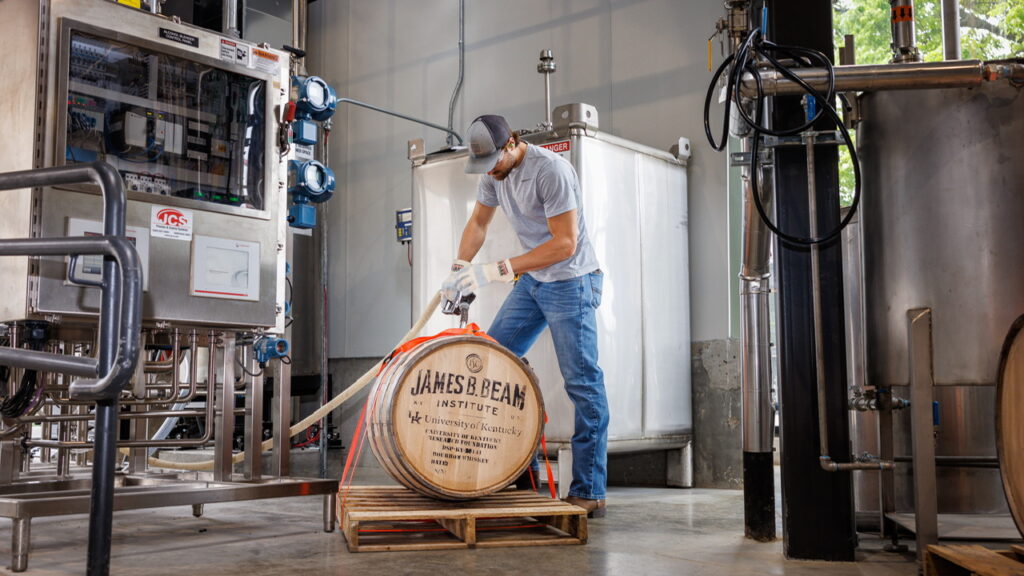
The University of Kentucky James B. Beam Institute for Kentucky Spirits (JBBI), in partnership with the Kentucky Energy and Environment Cabinet (EEC), has completed the first phase of a pioneering project exploring hydrogen as a sustainable energy source for the distilled spirits industry. The initiative, titled “Kentucky Distilled Spirits Industrial Decarbonization and Sustainability,” marks a significant step toward reducing carbon emissions in whiskey production.
Hydrogen and Natural Gas Blend Used in Distillation
Led by JBBI Director Seth DeBolt, the team co-fired hydrogen with natural gas to power the distillation process at the institute’s on-site distillery. The hydrogen-natural gas blend was used to feed the boiler that generates steam, which in turn powers distillation. Working alongside JBBI Head Distiller Glenna Joyce-Welsko, DeBolt and his team closely monitored the production over three months. The experiment resulted in 20 barrels—10 distilled using the hydrogen blend and 10 using only natural gas—now aging at the Independent Stave Company Boswell Family Barrel Warehouse for four years.
Collaborative Research Drives Sustainable Innovation
The project was in collaboration with the University of Kentucky Center for Applied Energy Research (CAER), a leader in hydrogen and energy innovation. “Co-firing natural gas and hydrogen in bourbon production is a novel concept, and we are thrilled to see some promising data coming from the project,” said Rodney Andrews, CAER director. “We look forward to seeing what happens next.”
“Hydrogen as a form of energy in the U.S. could be great for distilleries and the applied food industry,” said JBBI Director Seth DeBolt. “Our distillery at the institute provides the unique capability to conduct this test while tracking key information on production quality and safety.”
Testing Flavor Impact and Long-Term Viability
The next phase of the project will occur after the spirit completes its aging process. Researchers will evaluate whether hydrogen-based distillation affects flavor or quality. Early data suggests the distillate produced with hydrogen is high quality, supporting JBBI’s hypothesis that hydrogen can be a viable, flavor-neutral energy alternative.
Kentucky’s Energy Leadership
“Today’s news is another great step for Team Kentucky’s ‘all-of-the-above’ energy strategy,” said EEC Secretary Rebecca Goodman. “The successful blending of hydrogen in the distilling process is a great example of innovation and teamwork in action.”
The project was funded by the U.S. Department of Energy’s State Energy Program and aligns with Kentucky’s broader efforts to advance sustainable energy solutions for its signature industries.
For more information on the Beam Institute, visit beaminstitute.mgcafe.uky.edu.
Listen to Bourbon Lens on your favorite podcast app or stream on Spotify. If you’d like to support Bourbon Lens, join our Patreon, sign up for our “Weekly Pour” Newsletter, and don’t forget to follow us on Facebook, Instagram, and X.
Recent Bourbon Lens Coverage
- Koopers Whiskey Announces Limited Cognac Cask-Finished 7-Year Rye

- Oscar Mayer and Evan Williams Launch New Maple Bourbon Bacon
- Basil Hayden Expands Core Whiskey Lineup with New Golden Rye Release

- MGP to Temporarily Halt Whiskey Distillation at Lux Row & Limestone Branch

- Breckenridge Distillery Relaunches Honey Whiskey Made with Rare, Nigerian Goldswarm Honey
- Jim Beam Launches “Home Field Advantage” Campaign and Limited Edition Bottle with U.S. Soccer