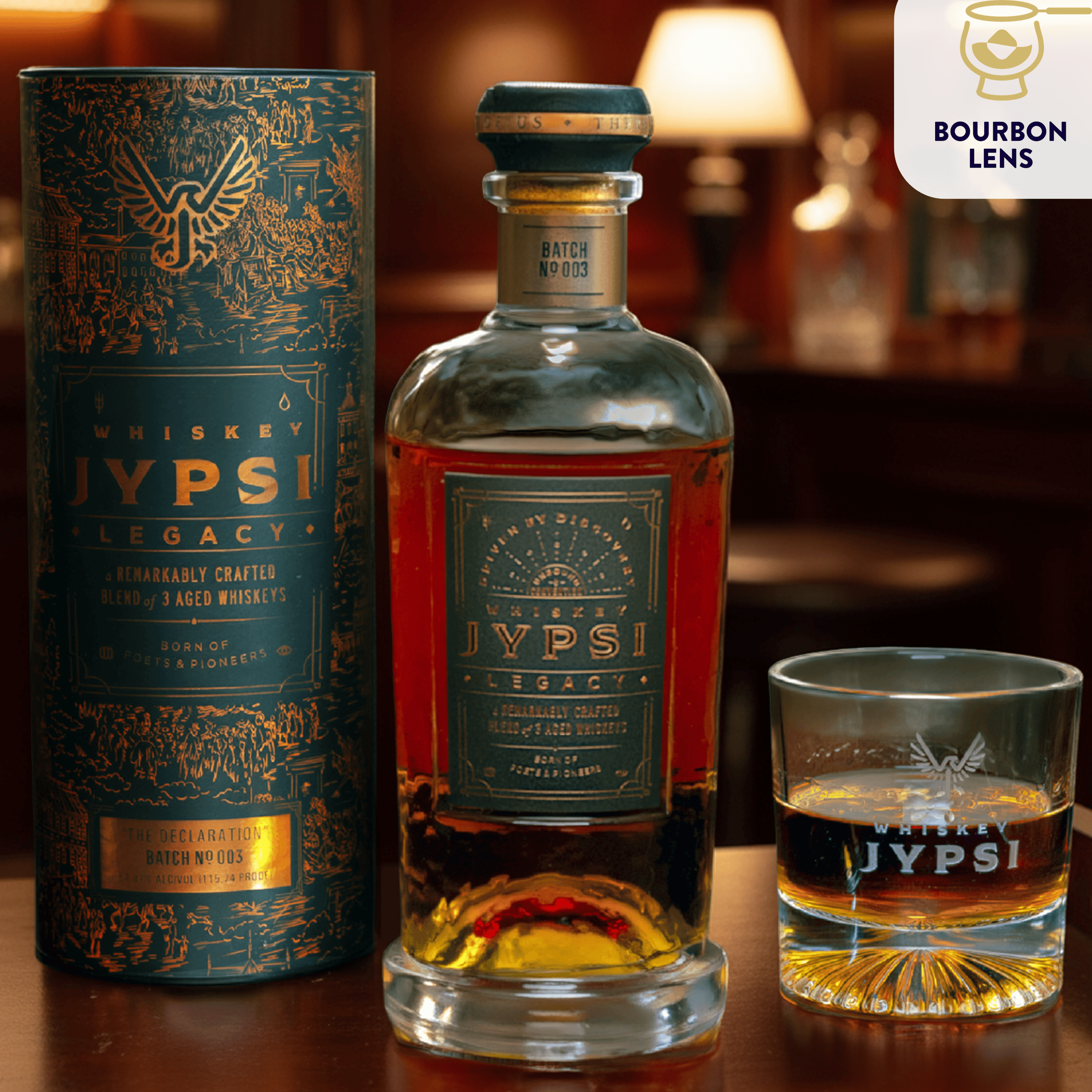
383: The Revolution of Blending: How Ari Sussman and Whiskey JYPSI Are Rewriting American Whiskey History

Whisky JYPSI Decleration

383: The Revolution of Blending: How Ari Sussman and Whiskey JYPSI Are Rewriting American Whiskey History

Jake and Scott sit down with Ari Sussman, master blender behind Whiskey JYPSI, to discuss Legacy Batch 003 "The Declaration" — a groundbreaking blend of Indiana rye, 25-year Canadian corn whiskey, Virginia single malt, and apple brandy barrels from George Washington's Mount Vernon Distillery. A must-listen for fans of American blended whiskey and independent spirits.

The “celebrity whiskey” category is crowded, to say the least. It’s a landscape often dominated by outsourced liquid, shiny labels, and minimal involvement from the names on the front of the bottle. But every so often, a brand comes along that completely disrupts the status quo.

Enter Whiskey Jypsi—the brainchild of country music superstar Eric Church and entrepreneur Raj Alva. But while Church provides the creative soul, the brand’s technical brilliance belongs to one man: Ari Sussman.

Sussman, an industry iconoclast who cut his teeth working wine harvests in Bordeaux and distilling in Michigan, is the mad scientist behind Whiskey Jypsi’s most ambitious release to date: Legacy Batch 003: “The Declaration.”

We recently sat down with Ari on the podcast to take a deep dive into the agriculture, the insane logistics, and the historical reconstruction that went into creating this incredible bottle.

Reconstructing a Forgotten Spirit: Maryland Rye

Before Prohibition, Kentucky wasn’t the undisputed king of American whiskey. Pennsylvania and Maryland were powerhouse regions, known for distinct, regional styles of rye. While Pennsylvania rye was robust and spicy, Maryland-style rye was famous for being smoother, rounder, and deeply fruit-forward.

To honor the upcoming 250th anniversary of the American Revolution, Sussman didn’t just want to recreate a style—he wanted to build a liquid timeline.

“The Declaration” is a masterclass in cross-category blending. It features an incredibly complex three-part architecture:

  1. 60% Indiana Rye (8 to 12 Years Old): To provide that foundational, spicy punch.
  2. 30% Canadian Corn Whiskey (25 Years Old): Delivering an ultra-velvety, aged mouthfeel and rich caramel sweetness.
  3. 10% Virginia Single Malt: Adding an earthy, grain-forward elegance.

But the real magic lies in the finish. Sussman sourced actual apple brandy barrels directly from George Washington’s Mount Vernon Distillery. By finishing the Indiana rye in these historic casks, he managed to recreate the exact orchard-fruit notes that defined late-18th-century Maryland ryes.

Hidden History in the Proof

If you look closely at the bottle of Legacy Batch 003, you’ll notice an incredibly specific number on the label: 115.74 Proof. That isn’t a random barrel strength. Sussman purposefully blended the whiskey to hit $115.74$ as a hidden Easter egg for history buffs. Transposed as a date, 11/5/1774 marks the day the historic Marlborough Resolves were signed in Maryland—one of the earliest formal declarations of resistance against British crown rule, predating the actual Declaration of Independence by nearly two years.

Pushing the Boundaries of Whiskey Agriculture

Our conversation with Ari didn’t just look backward; it took a bold look into the future of distilling. Sussman is at the forefront of agricultural innovation in spirits, discussing everything from the revival of heirloom grains to the pioneering use of gene-edited varietals (like the fascinating “Lavender Haze” grain) designed to alter the sensory profile of a distillate before it ever touches wood.

Whether you view Whiskey Jypsi as a collector’s dream or a punk-rock middle finger to standard sourcing practices, one thing is certain: Ari Sussman is proving that American blended whiskey can compete with the finest luxury spirits in the world.

Read the Full Breakdown & Listen to the Interview

Want the full scoop on how Eric Church stays involved in the blending process, the technical science behind stave finishing, and our live tasting notes for Legacy Batch 003: “The Declaration”?

Legacy Batch 003 is available in highly limited quantities at select premium retailers. Have you been lucky enough to score a bottle of Whiskey Jypsi? Let us know your thoughts in the comments below!

🔔 Subscribe for more weekly discussions, tastings, and bourbon insights from the Bourbon Lens community.

📸 Follow on Instagram: @bourbonlens

🌐 Visit: www.bourbonlens.com

Discord: https://discord.gg/pd6ys5nRSU

Listen to Bourbon Lens on your favorite podcast app or stream on Spotify. If you’d like to support Bourbon Lens, join our Patreon, sign up for our “Weekly Pour” Newsletter, and don’t forget to follow us on FacebookInstagram, and X.

Episode Transcript
Jake Lewellen (00:01.054) Welcome back to another episode of the Bourbon Lens with Jake. Unfortunately, Scott is experiencing May, which is May-Cember, a lot of people call, because there’s as many activities to do in May as there is in the holiday month of December. So, it’s just me. So sit back and buckle into the latest episode of the Bourbon Lens. We are joined by Ari Sussman, the man of many colors, really, in all… shapes and sizes. You heard him earlier this year in a different uniform, but this time he is talking whiskey Jypsi So Ari, it’s always awesome to connect with you. And I appreciate the pre show. We didn’t record that, but the pre show with you and, and Laura got a shout out our PR teams that we get to work with. Laura’s bad ish is one of the best in the business. But appreciate the 30 minutes before we even hopped on to record tonight. Ari Sussman (00:49.462) It’s great just catching up with you and Laura as well. You’re right. She is the best in the biz. Jake Lewellen (00:55.529) Yeah. It’s something that I don’t ever take for granted because, know, we talked about this a little bit. You know, tomorrow’s not promised. We’re not promised new whiskey, new conversations. And sometimes you got to create your own content, which that’s fun too. But it’s always good when you get to sit down and talk to the whiskey makers, right? And the whiskey minglers, right? Cause you all are doing so many cool things to create brands and profiles and whiskey JYPSI kind of that in the heart of it all, right? all your alchemy, the things that you wanna do and turns it into some really cool whiskey. So we’re gonna be talking a little bit about the new declaration that’s been out for a while. But first, before we get into the whiskey conversation, I think it’s always good to catch up on what’s going on with the brand. It’s been a while since we connected. How’s the brand going? I know you’ve got your legacy, your higher proof or higher cost stuff, and then you’ve got a more everyday consumer product now. So how’s the brand going? Ari Sussman (01:54.803) It’s actually going great despite what you read in the headlines. As we mentioned, we have three sort of standard expressions. We have legacy, which is our take on international cross category blending. We release one every year. And in general, the inputs are pretty rare or old. And so we can’t produce a ton of it, generally sells out. And it’s a lot of fun. In every case, a legacy blend is a blend that has not been to market before. They’re always novel, they’re always new, they’re always kind of interesting, blending together whiskeys that have never blended together before. A step down from that, in the kind of $70 price point, we have our Explorer series, 103 proof, minimum six years old, and we source oak from Appalachia and the Troncet forest in France. So it’s a really nice kind of hyper regionally specific blend of French and American oak with a nice mid-ride bourbon. And then sort of at the most approachable, accessible level, we have Tribute, which features Cherokee White Eagle corn. It’s also double barreled. It’s four years old. The reason for that is we didn’t want the wood to obscure the grain character. really tribute looking at the grain character. And once you get into five, six, seven years old, it’s a little more difficult to pull that grain character out. You want to have that in a slightly younger whiskey, which we also double barrel to give it a nice frame. So between those three products, we’re talking about blending. We’re talking about the influence of wood and we’re talking about the influence of grain, which are sort of the three legs of the whiskey maker’s stool. Those are the things that we think about when we think about how to elevate whiskey. In addition to that, we are doing a lot of LTOs and special releases. We have a really robust single barrel program called Barrel Seekers. We’re about to launch a wood finish series called Finish Seekers. You can find it on our website. And we also have a number of really fun collaborations with non-whiskey brands coming out in the near future. Lots going on. Jake Lewellen (04:11.688) Yeah, so I mean, got your, yeah, you got your toes and everything. And, you know, it’s kind of interesting, you know, because of, know, where the brand starts, right with, with Eric, it’s kind of funny just to say Eric, but Eric Church, right. And Raj and yourself, you know, you all have different backgrounds. They’re all very unique when it’s coming to creating this brand. And so, you know, you look at, you know, his persona, it’s kind of bucking the trend, not doing the normal thing. Right. And so, that gives you and your kind of eclectic mind an opportunity to go in and chase these unique expressions. you know for you as someone who is a creator right how does you know your your team’s opportunity to allow you to create get you excited to come to work and work on these expressions. Ari Sussman (05:05.109) I mean, excited every day and the excitement really starts at the top. You mentioned Eric Church is one of the co-founders of the brand. The other co-founder is Raj Alpha. There’s just two owners and funders of this brand. So there’s no outside money. This is two people who love whiskey, who built a team, myself included, but there are many others on the team in order to experiment and to be playful and to be exploratory. in whiskey and really ask questions and figure out where are the places that we can pull the levers that increase the amount of quality in the whiskey. So all of that experimentation, that kind of, that spirit of let’s go figure out new and better ways of doing things, that starts up there with Raj and Eric. And it trickles all the way down and it makes it easy to get up in the morning and go to work because you know you’re surrounded by supportive, enthusiastic, passionate people at every level in the company. Jake Lewellen (06:08.072) Yeah, and I think, you know, when you when you think of the term, you know, celebrity brand, right? A lot of times people get put off by that. But it seems like, you know, Eric Dirk Spentley, like people who are more like hands on that want to be a part of that they talk about the whiskey. You know, those are the ones that fans connect with. There’s been many of people try to get in on tequila or bourbon or whatever. And it’s like they’re so hands off and like they don’t know anything. It’s when the top gets in their hands dirty, right? And so if you look at the media coverage or the content that you all produce as a brand, it’s kind of cool when your leadership is all in too, right? If they’re half in, half out, it doesn’t really work. But you all have leadership that’s all in, I think also drives people to the band or to the brand because you have some loyalty around their fans and they’re talking about the whiskey as well. Ari Sussman (07:06.953) Yeah, and I think, you you can look at our bottle and it’s unlike most celebrity whiskeys. There’s no name, no signature. Eric, who has millions and millions of followers and can sell out arenas around the world, made it a point not to put his name on the bottle. It’s a brand owned by a celebrity, not a typical celebrity brand. It’s his actual capital and Raj’s capital in the company. It’s not a licensing deal where a large company is leveraging a celebrity’s appeal in order to mainline their product into a fan base. It’s not that, sometimes I think that we could put out a $30 product and put Eric’s face on it and the fan base would go crazy, but that’s not what we’re about. That’s not what interests us about whiskey. We’re really interested in figuring out where is this next phase, this next era of whiskey going and can we maybe kind of help nudge it along by focusing on quality ingredients, creative blends. narrative and really pushing back on the boundaries that defined the previous era of whiskey and really at the towards the end of it constrained it. Jake Lewellen (08:13.673) Yeah. Well, and I think that’s, you know, let’s push in there. I think that’s a really good, place to push because you’re someone and you mentioned it with, you know, the tribute, you know, pushing the grain part of this, right? The next evolution of that. think, you know, you are someone in the industry who has done that heirloom grains, new riff, right? Like there’s just people who get it that when you try to bring something back, you are calling to yesteryear and creating flavor profiles that made the whole world fall in love with bourbon pre-prohibition, right? And so I love that you all are doing that. So what’s it like not just to work with the whiskey, but the actual agricultural component of this? Ari Sussman (08:58.261) Great question. And I come from wine. And we understand that wine starts in the field and it starts on the vine. And it matters what sort of varietal of grape is used and what type of soil and what was the climate and the weather in a particular season. All of that is going to impact the character of the products in the bottle. And of course, in whiskey, when the accountants took over procurement and they made their decisions based on Jake Lewellen (09:00.776) Yeah. Ari Sussman (09:26.577) yields and scalability rather than flavor, which is, you know, one of the things that defines the past 20, 30 years of whiskey production. It left a huge opportunity for people that want to reconnect whiskey to nature, who want to understand it as an expression of value-added agriculture. And that’s what it was prior to prohibition. That’s what it was around the world for very long time. That’s what it was in early colonial America, where distilled spirits It was a way of turning your surplus grain into value. Of course, in early America, whiskey could be used as essentially tender. You could use it as money, you could barter. In many cases, the money was practically worthless, but whiskey was useful, right? So it could be used to exchange goods and services. So it feels, when we think about our role in trying to put Jake Lewellen (10:12.425) Yeah. Ari Sussman (10:23.892) quality grains, quality agriculture, not just good tasting grains, but grains that carry meaning and have a narrative component to them. And they have to taste good, but in many cases, the grains also have an additional layer of meaning, like where they come from. This feels very clearly like part of the next era of whiskey. And the companies that are still defaulting to inexpensive flavorless grain as a basis for their product, I just, I don’t know that’s going to land with the consumer in the same way. Jake Lewellen (11:01.515) Oh, for sure. you know, when as an agricultural guy myself, everyone is like, Oh, well, you’re a bourbon guy. I’m like, no, ag first ag econ, university of Kentucky, baby got my got my bachelor’s in science from there. You know, understanding that there’s like the the rye project of Kentucky. We don’t think of rye being a crop in Kentucky at all, but there’s a whole movement to bring rye back to the state of Kentucky, which, you know, was all over the place, you know, 150 years ago. And so it’s like, it’s cool just to see like, Hey, could we produce a lot more here in the state that we’re not even thinking about to bolster whiskey production or do unique things? Like that’s what gets me excited about the future of bourbon is, know, can we bring some of these things back? Can we change the landscape because yeah, yellow dent number two corn has produced a lot of really good whiskey like I’m not gonna not gonna knock on it, but I want you know an air stook rye or you know some random thing that I’ve never heard of To change my flavor profiles to waken my palate up to Be like, that’s exciting. I want to go back to that because it’s so different than X Y & Z Ari Sussman (12:26.344) Yeah, know, let me, a number of great points you just made, you know, just to piggyback off of them. Number one, it’s not required to have 100 % of an heirloom grain in a bourbon to impact its character. We found that 10 % of a mash bill, for some grains, 5 % of a mash bill, but usually between five and 15 % of a mash bill using heirloom grains can impact that flavor and aroma. Jake Lewellen (12:46.986) Mm-hmm. Ari Sussman (12:54.452) but still keep the overall character something that folks will recognize and be comfortable with. Once you get to 30%, 50 % heirloom or 100%, it can often have a lot of taste. And it’s kind of the difference between, you know, if you’ve only had McDonald’s hamburgers for your entire life, but then you have a sort of a grass-fed, you know, well-aged, you know, really quality meat burger, and you’re like, it doesn’t taste like what I’m used to. Well, have a couple more bites. You’ll figure out that it’s a lot better than what you had before. You know, not to disrespect McDonald’s, you know, it’s not necessarily the best burger in the world. And because you mentioned University of Kentucky and agriculture, and we’ve been talking about heirloom grains and kind of reviving these older grains, feel free to check out the paper we wrote and presented at the BEAM Conference, which says we should continue. to find heirloom grains and experiment with them and see how they can impact whiskey, because we know that varietals impact the character of a spirit. However, we are distillers who for the first time now have the ability not just to go into seed banks, but we have the ability to imagine new grain varietals with certain organoleptic properties. And using gene editing software and techniques, we’re the first generation of whiskey makers who can go in and very quickly develop new varietals of grain. So looking backward is one of the tools that we have, but our imagination and the tools at our disposal where, know, fools like me can go in and say, I want to create a rye or a wheat that has really high levels of linalool. And this is the paper that we wrote and presented at the Bean Conference. We want to create a new variety of rye that, where we take the… where we basically fore-ax the sensory threshold of the compound linalool, which smells like lavender, just to see if we can do it. And so we’re in the process of developing a new variety of grain called lavender haze, named after a Taylor Swift song, the opening song from the album, Midnights, that will make really wonderful bread and bagels and whiskey. And we’re the first generation of distillers that Jake Lewellen (15:04.339) Yeah, that’s funny. Ari Sussman (15:15.976) has the opportunity to use our imagination to create new spicy or vanilla flavored or whatever. And similarly, I think we’re also the first generation that can start thinking about creating new species of oak. We’re not going to be able to enjoy it ourselves, but 200 years from now, we have the ability to oak, American oak that has characteristics of Mizunara or Hungarian oak or new flavor compounds in it. And so we can think about, you know, how might the folks that come after us make whiskey 200, 250 years in the future. Jake Lewellen (15:56.012) Yeah, it’s, you know, hybrids have always been a thing, but creating something from complete scratches is completely different, right? Like cross pollination, right? It’s been around forever, but coming up with something, you know, from the ground up and you know, as Rob Samuel’s always said, if you can’t make a bag, can’t make a loaf of bread with it, then what do you do? That’s the maker’s mark story like in a nutshell. But you know, I agree like the grain has to be good for not just distillation. It should be good across board. I should be able to consume it and I should be able to, you know, drink it once it’s distilled properly in some way, or form. Ari Sussman (16:37.907) Yeah, no, and we should expect the same levels of quality from our whiskey that we do from our chefs, right, at our favorite restaurants. So. Jake Lewellen (16:46.367) Mine happens to be McDonald’s, but you know, I just figured. I just had to throw that out there. It might be my son’s, but not mine. is, you know, when the ice cream machine’s working though, they’re soft serves pretty on point. Ari Sussman (16:53.447) Yeah, yeah, you know, it’s a modern Marvel, right? Ari Sussman (17:03.795) Yeah, yeah, yeah, no, they can they head to head with Dairy Queen. They’re right there with that soft serve. Jake Lewellen (17:09.427) Yeah, makes me hungry. But anywho, you know, I do think it’s really cool when you can play with so many things, right? Whether it’s the agricultural, the barrel, obviously, we’ve been able to explore so many different types of barrels. And so you said something there that I find interesting. It’s like, Okay, so we’ve we’ve had you know, one kind of species of white oak that we’ve really kind of used for barrel production for forever. You know, people have gone into Gary oak or you know, French oak has been more popular. But do you see kind of a space where people are creating a American white oak hybrid with like a mizunara and then planting that in some type of field and doing some type of, you know, tree farm? Is that something that you see on the precipice. Ari Sussman (18:07.325) Yeah, we’ve experimented a little bit with kind of cooper in our own barrels using a variety of staves and heads. And that’s not a course of action that we ourselves, we didn’t invent that. think Compass Box and a couple of other companies that have strong relationships with their cooperages like we do have experimented with creating barrels that have different types of wood. I have this desire to make a… a whiskey, maybe a barrel of it every year, where it’s say a Kentucky bourbon, right? But you’re selecting the best grains from wherever they come from in the world. And you just make one or two barrels of it. And maybe the corn comes from Oaxaca and the malt comes from some island around Scotland and the rye is some right Germany, wherever, Scandinavia, wherever the ingredients come from. And every year you make one barrel of it. Jake Lewellen (18:52.182) Germany. Yeah. Jake Lewellen (18:57.642) Yeah. Ari Sussman (19:03.859) And in addition to the grain bill being unique in which varietals are being used, it would be fun for just that product to have a completely unique barrel that has some combination of, you know, this is a Japanese and, you know, Japanese heads and, you know, French single malt body or a wine body. And you can, we just have complete control and our imagination is our only limit. And so using better ingredients across the board for one of one barrels. I’m a huge fan of staves as well for a lot of reasons. My two favorite reasons why I love staves, oftentimes more than barrels. Yeah. Yeah. Jake Lewellen (19:38.986) Yeah. Jake Lewellen (19:45.792) So stay finishing. me just ask that question. Stay finishing. So dropping a stave into a, okay, yeah. Ari Sussman (19:53.105) Yeah, stave is a means of augmenting a mature spirit. And what we’re able to do with staves, which we could never do with, a secondary barrel that we would traditionally use to take a wasting kind of push in a different direction, is that number one, with staves, you have a lot more control over the quality of the wood. You can select higher quality wood than you ever could in a barrel. And number two, I think it’s really fun to be able to adjust the surface area to volume ratio so that Jake Lewellen (19:56.181) Yeah. Ari Sussman (20:22.738) A barrel just gives you one surface area to volume ratio, and you can control the proof and the contact time. Those are the two variables that you have control over. But with staves, you have the ability to essentially make that spirit interact with half a barrel or a quarter of a barrel or three barrels simultaneously, right? And for a short amount of time, then you can remove them like a tea bag. So I think whiskey makers have more tools at their disposal right now between wood and grain and There’s obviously abundant stocks of mature whiskey that need to be engineered for distinction in one way or another. can’t just kind of harvest the barrels and put them out there. They need to be augmented or made more interesting and compelling. yeah, I think it’s as exciting a time as it’s ever been. Jake Lewellen (21:10.796) Sure, I’m still, I’m waiting for people to really go in on Solera here in the States. I know Chattanooga does it, but I think Solera is another thing that you can do to create that vatting process. be a great way to you know change the batch you know vario from year to year if you’re using that t-bag system right to drop staves in there and like okay well we dumped this and this was cabernet and now you know, we dropped it down to, you know, 20 barrels left and now we’re going to add a cognac, right? So making sure that the flavor profiles are different. And I think the category of American whiskey will be very interesting as well, because talking about different barrel sizes, right? As a winemaker, you know, like different size barrels can give you different extractions, different things. And High quality barrel making right? We’ve been so like kind of like everything has been quick from a barrel making But like what happens when you elevate to like a sagu manro when the barrel actually cost? Eight nine hundred dollars or a thousand dollars for the barrel. It’s tight. It’s not leaking. You know, it’s it’s like it’s the Cadillac right of barrels like And to be honest I’ve had whiskies in sagu manro it just tastes better Like, it’s kind of crazy. Ari Sussman (22:38.416) Yeah, better grain, better wood. We can argue about the percentage, but let’s just say 70 % of the character of a whiskey comes from that barrel. That barrel should be the biggest concern of the whiskey maker of anything, right? Because that’s where the majority, the spirit itself has to be optimized for whatever character the whiskey maker envisions and it has to be clean and properly made with high quality grains. But then the choice of Goopridge is like, Jake Lewellen (22:44.938) Yeah. Jake Lewellen (22:58.965) Yeah. Ari Sussman (23:07.282) make or break for an entire company, for an entire investment. It’s like focus on the whiskey and again, we’re coming out of an era where more was better, right? Can you make 20,000 barrels a year, 50,000 barrels, 100,000 barrels a year? How many barrels can you get? Do you always know what cuprage they’re coming from? Even if you’re working with the cuprage, do you understand where the staves themselves are coming from? Right? Because a cuprage can source staves from all over. So having control over that entire process as we do, it takes a lot of work, but I think ultimately yields a more interesting spirit. I can tell you from a manufacturing point of view, it’s a lot more fun to get to know all of the people involved in the processes, your entire supply chain from the farmers to the folks that own the oak stands to learn how they’re harvesting, sustainable practices, how they’re curing the wood, how they’re either coopering it into barrels or finishing it into staves. You have to have all those relationships in order to make the best possible spirit. Jake Lewellen (24:16.616) It’s amazing. Some of my best experiences from a tour perspective, behind the scenes media person, right? Going to Kelvin Cooperage and seeing someone who’s done that for like a long standing time taking tradition from Scotland and bringing that to America or seeing Jack Daniels before and Brown Form before they closed their They’re different cuprages like People always go for the flame the flames cool but like to see people like these master whiskey barrel makers like isn’t it’s an art and And like seeing this the the kilns and the drying and the seasoning like it’s a whole thing that you don’t think about for For the production of the actual liquid that is just it’s just an art form, honestly Ari Sussman (25:11.846) Yeah, no, it’s one of the very important plants in whiskey production. I don’t know if you’ve read the Drunken Botanist. I think it’s a fantastic book and it gets into when you’re drinking a whiskey, you’re not only drinking the three base grains that are in it, but there’s the fungus, there’s the yeast, right? That’s another life form. And then of course there’s the oak, there’s the barrel, that’s another plant that is central to the whiskey making process. And by the time you’re drinking… Jake Lewellen (25:29.185) Yeah. Ari Sussman (25:40.007) a glass of whiskey, you have a whole handful of plants going on in your glass. It’s really an agricultural marvel. Jake Lewellen (25:47.512) So let’s speak about what’s in the glass. We’ve talked a lot about the nerdy things, which I love and I hope everyone listened to at this point. We’ll probably pull this part to the front of the episode so you can just hear a little snippet. But we have in our glass the declaration. So this is Legacy 003 or Batch 3, I don’t know how, Volume 3. I knew I’d get it right eventually. Ari Sussman (26:09.292) yeah. Jake Lewellen (26:12.051) This is, first of all, I love the name, a reimagined Maryland style rye whiskey. So as a whiskey kind of historian nerd that you are, as I am, explain to me what a yesteryear style Maryland rye would kind of like component be. And then let’s work back there to what we have in our glass. Cause I think that’s an important piece of the conversation when you talked about reimagining what a Maryland style rye is. Ari Sussman (26:41.841) Absolutely. So the concept for the declaration, we knew that we wanted to release a special spirit in commemoration of the 250th anniversary of the Declaration of Independence. What we did not want to do is write 250 on a label and put an American flag there and say, this is the same old juice. going to dial it in. We’re just going to write 250 and it’ll be a nice collectible bottle. We actually wanted to think a little bit more about the whiskey making process and how whiskey was made and what inspiration we could draw, how we could riff on the way whiskey was distilled 250 years ago. I think leading up to talking about Maryland style rye, prior to 1776, most of the spirits that Americans drank was rum. We were a colony of England. And England had colonies all over, including sugar plantations in the Caribbean. That molasses would work its way up to New England, would be fermented and distilled into rum. And when we were colonists, we drank mostly rum, as far as distilled spirits go. 1776, we sever the tie that binds us to the crown. We’re a new country. That flow of molasses stopped. But we were still thirsty. Jake Lewellen (28:07.903) Mm-hmm. Yeah. Ari Sussman (28:10.949) And at the time, the center of whiskey production or spirits production was in New England, kind of going down from Boston, down to Pennsylvania. Of course, we’re familiar with the whiskey rebellion. And at that time, the main grain that grew there, because when the folks came over from primarily Europe, they brought this grain with them, was rye, right? So before bourbon, there was rye. Rye was the whiskey of early America. We can talk a little bit about why rye doesn’t always grow great in a place like Kentucky. Rye needs to vernalize. It needs to get really, really cold. Some people in the North say, you know, making rye whiskey in Kentucky is a little bit like making tequila in Canada. You can do it, but it may or may not be sort of regionally. In some cases, it’s regionally appropriate. In other cases, it’s a little bit of a stretch. But rye whiskey was the whiskey of the revolution and of early America. And it generally wasn’t aged in barrels, certainly not charred barrels. So rye whiskey, whether it came from Maryland or Pennsylvania, was generally pretty clear if it had any color. It was just in a used barrel as a means of storage and transport. Jake Lewellen (29:10.637) For sure. Jake Lewellen (29:33.357) Yeah. Ari Sussman (29:35.516) But different regions like Maryland and Pennsylvania and others had regional styles of rye whiskey. Today we have 95-5 that’s produced all over the place and it’s usually non-varietal specific grain. Most of it kind of follows the same fermentation protocols. Most of it’s distilled in the exact same kind of column still. It’s really, really phenomenal stuff. Larry Ebersol is the godfather of rye for a reason. But back in the day, there was a style called Maryland style rye that incorporated roughly 60 % rye, 30 % corn, 10 % malted barley. So it was a rye whiskey, but a third of it was corn. So it had sweetness and approachability to it. And that was a style of rye that George Washington made at Mount Vernon. Of course, when George Washington left the presidency, he was broke because he wouldn’t take any cash for it because he was a gentleman. He needed money, he had a farm, and by the time he died, he was probably the biggest distiller in the United States, 11,000 gallons a year, which is like substantial, right, for a craft distiller with no electricity. Yeah, and of course, his distillery was, you know, the productivity came from slaves. It was a very different scene, right, than… Jake Lewellen (30:46.74) for sure, back then. Yeah, heck yeah. Ari Sussman (31:03.665) that was different sort of whiskey, different sort of culture than what we can imagine now. But we wanted to get into all of that. As Whiskey Gypsies, we were thinking about how can we create a 250th anniversary product? And we wanted to look at the good, bad, and ugly of American history, in particular, the types of whiskies that are found in fathers like George Washington made at Mount Vernon. So when we say we sort of re-imagined a traditional Maryland style rye, we took those… Jake Lewellen (31:10.913) Mmm. Ari Sussman (31:32.593) proportion of the match bill, but instead of making a match bill, we’re not historical reenactors. We don’t dress up. We’re not cosplayers. We’re inspired by the past. We don’t kind of, know, cosplay it. So we thought it would be fun to make a blend following the ratios of a traditional Maryland style rye. So that 60 % rye component, we ended up making a blend of eight to 12 year old MGP rye for the 30 % corn component. We had Jake Lewellen (31:38.015) yeah. Jake Lewellen (31:42.957) Yeah. Ari Sussman (32:02.352) 20 to 25 year old Canadian corn whiskey, which we refinished in new American oak barrels in Tennessee for two years to give it a little bit more depth of character. And then for that last component, the 10 % malted barley, we used a single malt from Virginia, an American single malt. So it’s three different categories of whiskey, multinational, you the United States and Canada. And it’s a blend that was sort of an homage to the way that Whiskey was made places like Mount Vernon. But what was, I think, uniquely cool about this process, and we couldn’t have planned it, couldn’t, it’s not something we could have written a project brief ahead of time, was when we made a prototype of the blend and we shared it with our friends at George Washington’s Distillery at Mount Vernon, they really enjoyed it. They kind of, appreciated our approach to whiskey making, blending and kind of reimagining tradition. And they said, you know, what might make this even tastier is if you finish it in our Apple brandy barrels. And we happened to be harvesting some Apple brandy barrels at Mount Vernon. So our friends at Mount Vernon harvested the Apple brandy barrels. They shipped them to us. And we actually finished this whiskey that was inspired by Mount Vernon by the whiskey Mount Vernon made 250 years ago, we were actually able to finish it in Apple brandy barrels from Mount Vernon, which kind of made the story come full circle. Again, not anything we could have planned for. just, this is what happened. This is what happened when fate intervenes. And so it feels really good with the 250th anniversary to come up to have a spirit that… Jake Lewellen (33:40.129) Yeah. Ari Sussman (33:51.397) that not only is sort of unique and I believe tasty, but also has this actual connection to Mount Vernon to early American whiskey making. Jake Lewellen (34:01.378) Yeah, I mean, it’s a full sample. I don’t have a full sample anymore. You know, as we’ve sat here and talked and it’s, it’s definitely unique and I hadn’t I’d read the sell sheet and kind of walked away and then the Apple brandy piece makes a ton of sense because it’s a wisp. It’s not a bunch, but there’s enough there to be like There’s a fruit that you need to, like, you don’t know exactly what it is, but you get it, right? I love the balance of the corn sweetness from the corn whiskey, from the Canadian barrels. And you get a little bit of that marshmallow-y note, like, cause you kind of broke it down. Like all the sensory flavors come to your mind, right? As a whiskey person, it’s like, okay, well, if you’re finishing this in Tennessee, you know, those barrels, like, you know, you’re gonna get some marshmallow notes, like where that all comes out of that region, feel like, is marshmallowy, the way the barrels age there. And then I love the Virginia single malt component to give it that multi-balance, so it gives it a depth and complexity from a mouth feel perspective. You know, I really enjoyed this. love the kind of, you know, Maryland style, Kentucky style, right? Where it’s not like a huge right component. It’s it’s down at that corn component with the right. I 95.5 is fine, but man, there’s something to be said about this style or Mahonga, Neela and Pennsylvania or Kentucky style like a 51%. It just it’s got. more mouth feel and depth and complexity. It’s not just, you know, pine salt and mint. It’s just a lot going on. people who don’t know, eight to 12 year old whiskey from Indiana, where you got this from, that’s like the precipice of that rye whiskey coming out of that distillery. So great blend. Like it’s just really enjoyable. Ari Sussman (36:12.109) Yeah, so the foundation of the blend, 60 % of the blend, is itself a blend of eight to 12 year old whiskey. Every single cask selected, lots of prototypes made even just for that blend within a blend. In a blend within a blend, this is a technique that we borrow from perfumery, where they create something called accords. And oftentimes perfumers will make blends and then they’ll blend their blends. Jake Lewellen (36:19.917) Yeah. Ari Sussman (36:41.587) And we thought that would be a fun thing to do with the rye whiskey base, because you get a depth from a blend of eight to 12 year old that you couldn’t get from just 12 year old. The eight year old has a little bit more of that grain character coming forward. The 12 year old has more of the oak character. So what we tried to do is find a foundation for this blend that had all of that rye character that we were looking for. Because we wanted the end product to Number one, have a little bit of this rustic, spicy tone to it, because we’re really kind of thinking about early American whiskey making. We wanted to have a roughness to it, but for it to be restrained and kind of measured with sort of an overall elegance going on. But really within that elegance, having a little bit of a punch, like we’re not messing around. However, you know, some dude. Jake Lewellen (37:27.82) Yeah, I mean. Jake Lewellen (37:35.139) Yeah, well, so that’s the one thing is you can tell where it’s got some sharp edges at some places. It’s got some round like on the nose. It’s more rounded on the palate. And so as you talk through that, it’s like you get peaks and valleys in your nasal cavity and it’s allergy season here in Kentucky, pollen’s everywhere. luckily doing pretty good. And so that’s one of the things is you, and you look at your all cell sheet on this, there’s so many notes. You can go a lot of different ways with what you’re getting here. What’s the proof on this one? Ari Sussman (38:12.599) Well, good question. It’s 115.74. Proof. Jake Lewellen (38:19.682) Now are all of them right around 115 proof? Ari Sussman (38:24.035) Yeah, you know, they have been. It’s very possible that in the future, as we deal with extra aged whiskeys, that some of those are a little bit of a lower proof. So our main thing is we don’t want to really add any water. But sometimes and for future legacy releases, some of the the whiskeys themselves might be slightly lower proof. Some of might be slightly higher proof. But going back to the proof here, one of the things we all know the fourth of the lies 1776 as the date that the Declaration of Independence was signed. What we learned in our research is the Declaration of Independence that was signed in Philadelphia was in a sense the second declaration that was signed in that earlier in Camden, New Jersey, there was a declaration signed that was called the Little Camden Resolution, which was sort of the first, and it was in 1774, was the first time. colonists said, we’re going to band together and fight against the crown and we’re going to write our names on a piece of paper. And the date of that was November 5th, 1774, 11,574. And when you look at our proof, there is a little shout out to the little Camden declaration before, because our proof is a little bit of an Easter egg timestamp. Jake Lewellen (39:46.211) Well, there’s always something on these bottles, right? That you share with me and it never ceases to amaze me how much detail you can find if you’re having a conversation, right? And that’s best thing about whiskey is you think you know it and we could talk tasting notes for hours, but it’s like the little things like that. Like you put on a bottle and it’s like you’re in the liquor aisle and someone’s looking at that bottle and you’re like, Hey, did you know this? And they’re like, that’s pretty darn cool. And then, know, it’s, you know, I’ll pick that bottle up because, you know, I love an Easter egg versus it being again, like an American flag all over the bottle. It’s something unique and, know, pays homage to the great country live in. Whether you feel about it, you can talk about it. So it seems pretty great to me from that perspective. Is there any left is a good question. Yeah. Ari Sussman (40:43.619) We want to make sure that we’re inspiring conversations and if there’s little factoids and conversations that can take place, then we’re interested. Jake Lewellen (40:52.226) So Ari, is there any whiskey left? Is there any of the declaration floating around still for you all? Ari Sussman (41:05.869) There is some declaration floating around. So it’s in selected markets. We’re in about 19 markets. Is that what you’re asking? there whiskey? Yeah, we’re in about 19 markets. I’m not sure that the declaration is in all of them. Certainly you can go to our website and find where it’s available. And if it’s not available in stores near you, we have an online retail store like most any brand would these days. Jake Lewellen (41:12.63) Yeah, that’s exactly what I’m asking. Yeah. Ari Sussman (41:34.063) Yeah, we’re excited. We want to get this into people’s hands. It is limited edition. Obviously that 20 to 25 year old component in that eight and a half year old American single malt. There’s just not very much of that in the world. So, you know, unfortunately the, wasn’t as large a production run as we would have liked, but we’re very happy with the outcome with the product. And we couldn’t make as much as we like, but if you, if you’re into American history, if you’re into sort of modern international whiskey blends, and fun collaborations between sort of new brands and then old entities like Mount Vernon. We tried to put all of that into this bottle. Jake Lewellen (42:13.646) Yeah, no, it’s awesome. And I really appreciate you spending some time with us talking about what’s going on with Whiskey Jypsi a little bit about agriculture as we took a turn, but ultimately ended up here talking about the brand new whiskey that you all created. So if you’re looking for a bottle to celebrate the 4th of July and our 250th year, give this one a try because it’s going to be unique. And Ari, thank you so much for joining this episode of the Bourbon Lens. We’ll catch you next time. Cheers.

Listen & Subscribe

Never Miss A Drop

The Weekly Pour lands in your inbox every week with new episode alerts, bourbon news, and picks from Jake & Scott. Free. 

Scroll to Top