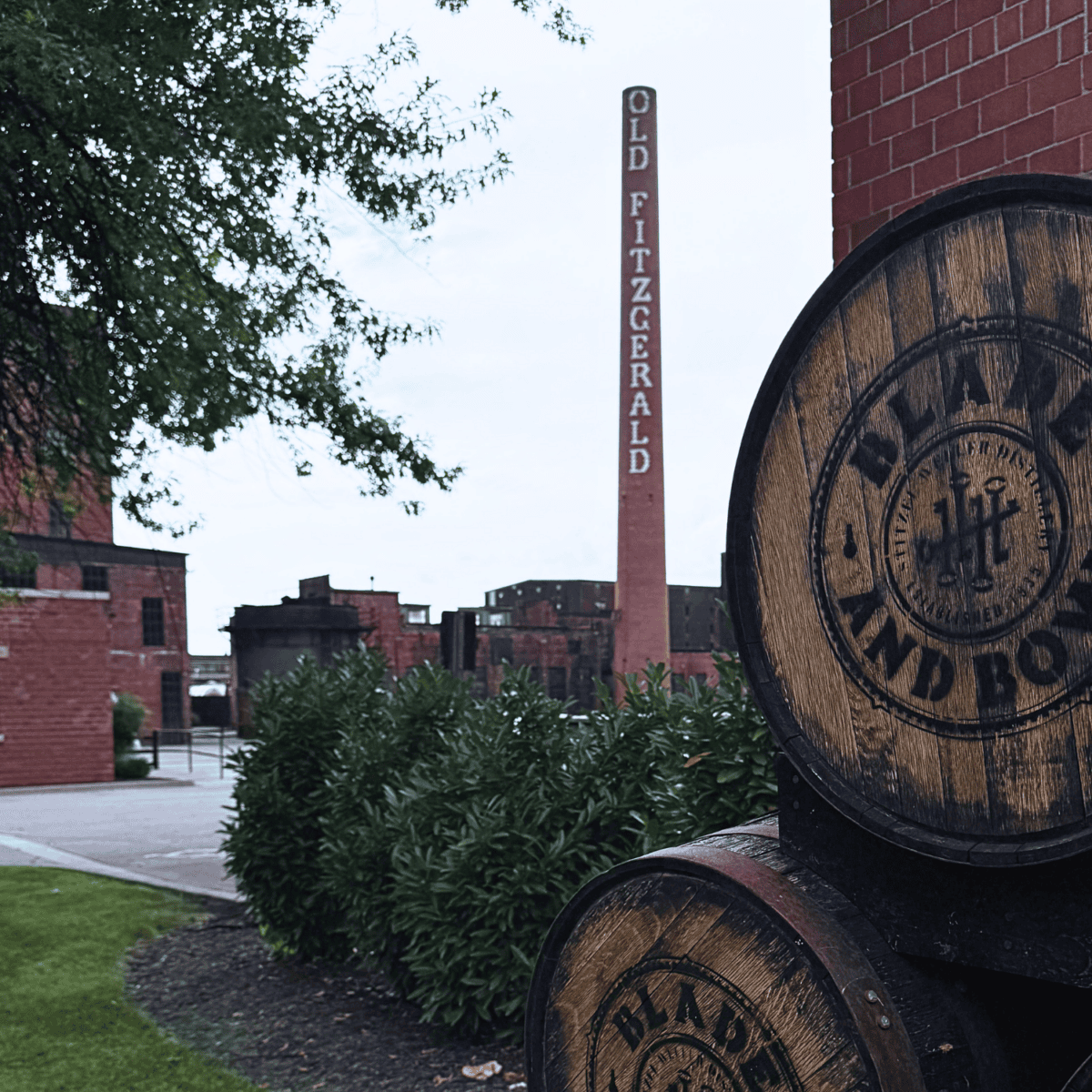
We celebrate our 400th episode this week with Nicole Austin, Diageo’s Director of American Whiskey Liquid Development and Capabilities, walks us through the new Blade and Bow 12-Year Solera Bourbon from the historic Stitzel-Weller Distillery in Shively, Kentucky.
The 104-proof release carries an MSRP of $64.99, positioning it as a rare combination of extended-age complexity and everyday accessibility in a bourbon market increasingly dominated by high-proof, high-price limited releases.
A Rickhouse Full of Secrets
Austin, who previously served as general manager and master blender at George Dickel’s Cascade Hollow, said Stitzel-Weller was the first place she wanted to explore once her role expanded beyond Tennessee whiskey.
“Stitzel-Weller was the first place I wanted to go,” Austin said. “The legend of this place looms so large.”
That curiosity led her into the site’s inventory reports and rickhouses, where she began pulling decades-old barrels — including three barrels of DSP-KY16 distillate from 1992 — to test a long-standing assumption in American whiskey: that liquid this old simply doesn’t hold up.
“I was expecting what everyone expects, you know, like tannin and acetone and not much else,” Austin said. “And I just found a lot that really defied that.”
Where conventional wisdom suggested only about one in ten ultra-aged barrels would be worth bottling, Austin found closer to three in ten — and in barrels that had undergone a historic process called consolidation, or “topping off,” as many as seven in ten.
The Science Behind the Age
Consolidation, common in Scotch and Canadian whiskey but rarely documented in American whiskey, involves combining the contents of half-empty barrels to slow the accelerated evaporation and oxidation that occurs once a barrel drops below its structural midpoint.
“You start with a hundred half-empty barrels, you end up with fifty full barrels, and now you have fifty spaces in the rickhouse that you can put new barrels into,” Austin explained. “My assumption is that that was the intent, and it was sort of secondary that it happened to deliver this incredible pause in the maturation process.”
Austin also credited Stitzel-Weller’s distinctive rickhouse architecture — patented by Frederick Stitzel and still used in fifteen of the site’s rickhouses — with helping protect barrels through extreme long-term aging.
Introducing the Solera Method to American Bourbon
For the new release, Austin adapted the Solera fractional-blending method traditionally used in sherry production, running parallel Soleras in vintage cognac, port, muscatel, and Bordeaux vats before blending the marks together at bottling.
“This sort of unique Solera process is what I had in mind of how to get there, given the constraints of our environment,” Austin said.
Every bottle carries a minimum age of 12 years, though some component whiskeys are as old as 18. Unlike many finished or cask-influenced releases, Austin said she designed the blend to avoid the “one-note” flavor pitfalls common in the category.
“It should read when you put your nose in the glass as, this is a much more interesting bourbon than I’ve ever tried,” Austin said.
Built for the Glass, Not the Shelf
Austin was direct about her goal for the release: a bourbon meant to be opened and enjoyed, not collected.
“It doesn’t matter what you accomplished if nobody drinks it,” Austin said. “It’s meant to be drank, it’s meant to be shared. I want people to feel like there’s a lot of value in that whiskey — that they’re getting way more than they paid for. That’s what I was hoping for.”
At 104 proof, Austin said the whiskey was built to perform on the rocks as well as neat — a deliberate rebuttal to what she called an industry-wide trend of “proof-chasing.”
“A lot of whiskies fall apart when you put ice in it,” Austin said. “This one just — it still has body and character.”
Where to Find It
Blade and Bow 12-Year Solera Bourbon is rolling out to retailers now at an MSRP of $64.99. Fans can follow The Bourbon Lens on Instagram for real-time updates on bottle drops, and visitors to Louisville are encouraged to tour Stitzel-Weller Distillery in person.
About The Bourbon Lens
The Bourbon Lens is a Louisville-based bourbon and American whiskey podcast hosted by Jake Lewellen and Scott, delivering interviews, tastings, and industry news from inside the bourbon world. Episode 400 was recorded on-site at Stitzel-Weller Distillery in Shively, Kentucky.
Follow & Subscribe To The Bourbon Lens
🔔 Subscribe for more weekly discussions, tastings, and bourbon insights from the Bourbon Lens community.
- 📸Follow on Instagram: @bourbonlens
- Visit: www.bourbonlens.com
- Join: www.patreon.com/bourbonlens
- Merch: https://bourbon-lens-shop.printify.me/products
- Mailing List: The Weekly Pour
- Discord: https://discord.gg/pd6ys5nRSU
Latest Bourbon Lens Podcast
- 400: Diageo Unveils Blade and Bow 12-Year Solera Bourbon at Historic Stitzel-Weller Distillery

- 399: Inside New Riff Distillery’s American Single Malt Whiskey: Blending, Barrel Care & Flavor Innovation
- 398: Penelope Bourbon’s Danny Polise Talks Classic Series, Cooper Series Growth in Bourbon Lens Return
- 397: Wild Turkey’s Bruce Russell Talks Record Summer, Russell’s 13, and Three Generations of Whiskey Making
- 396: Bourbon Lens Explores the Untold Connection Between Louisville’s Water and Kentucky’s Bourbon Legacy
- 395: Mugen Spirit’s Founder Kojin Tashiro Talks His Love Letter From Kentucky To Japan